Google AI Edge Foresight Review: Why Frontier Labs Move Into Apps, and Who Keeps the Token Rent
$\rm\LARGE{A}$I labs route or ration when they pay for the tokens, and leave the choice to you when you pay. That asymmetry, more than any single app launch, decides who gets paid as the labs move into the application layer.
I got there through a small product. This week Google released Google AI Edge Foresight, a free meeting notetaker for the Mac that runs entirely on the device, with no cloud subscription (TechCrunch, Notebookcheck). Notetakers are one of the busiest corners of the startup world: Granola raised $125 million at a $1.5 billion valuation in March (TNW). My first reaction was that free Google apps are going to kill a lot of startups.
Then I mapped every product Google Labs has shipped against the funded startups it competed with, and looked at how the labs price their own models. Token pricing mattered more than any app.
I ask: When a frontier lab moves into the application layer, who loses, and who gets paid?
The product, briefly
You type shorthand on the left; Foresight expands it into full notes as the meeting runs, Granola-style. It records the Mac’s microphone and system audio, so it works with any call app. A Sources tab builds a local knowledge base from your PDFs, docs and bookmarks for live Q&A during the meeting. Gemma 4 powers the assistant and EmbeddingGemma 2 indexes the sources.

What I liked: privacy by architecture, no bot joining the call, and the price. What is missing: it is Mac-only, with no team sharing or CRM link, and the same team’s earlier dictation app “didn’t make it to mainstream usage,” in TechCrunch’s words. As a product, Foresight is a small developer showcase. As a price signal, it is loud: it sets the public price of “transcribe and summarize my meeting” at zero.
Who pays for the tokens decides who routes
Here is one lab’s menu:
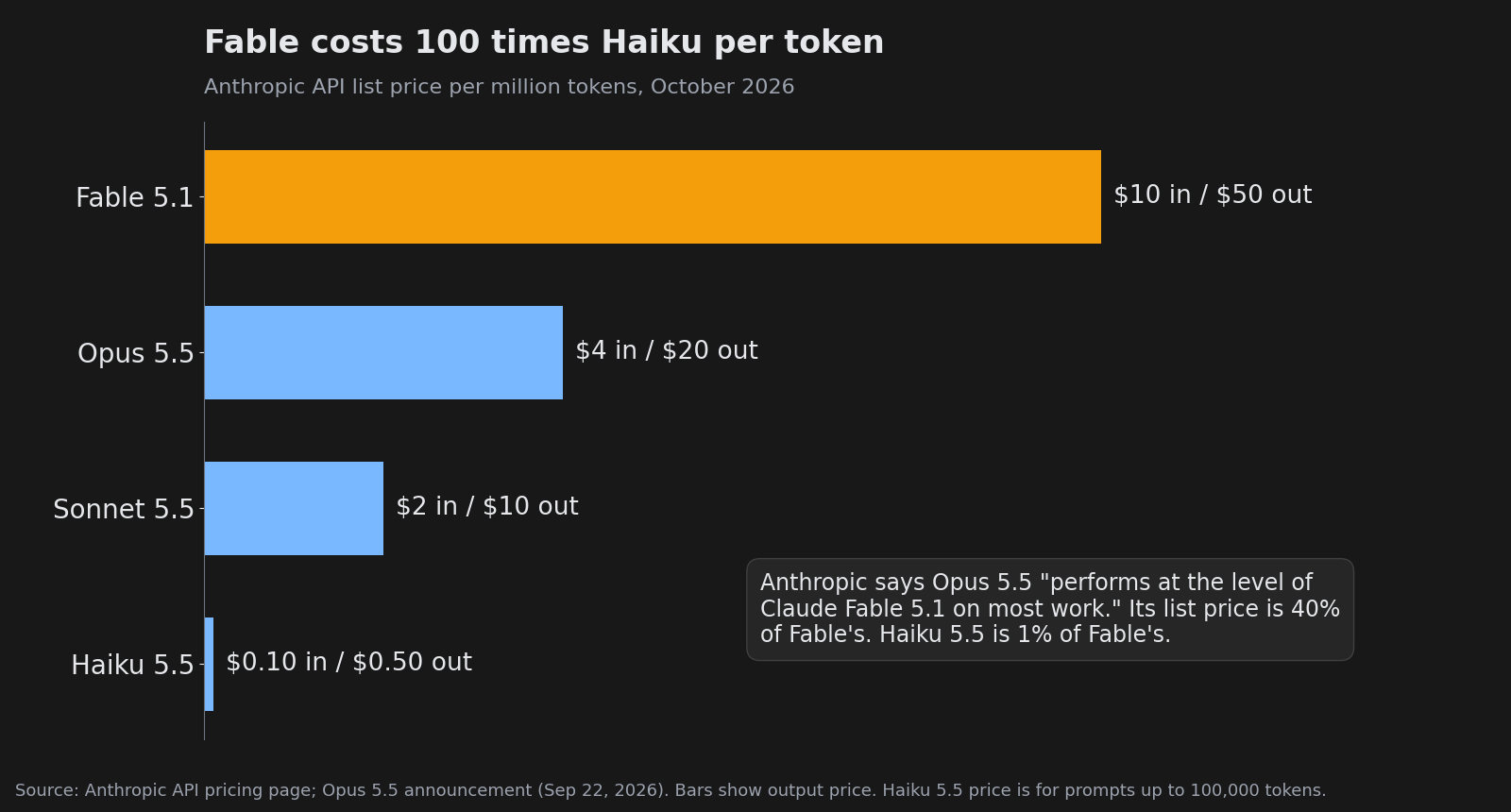
For prompts up to 100,000 tokens, Fable 5.1 costs 100 times as much per token as Haiku 5.5. Anthropic itself says Opus 5.5 “performs at the level of Claude Fable 5.1 on most work” (Anthropic, Sep 22, 2026) at 40% of Fable’s price. So by the seller’s own account, much of the work sent to Fable could be done for less, and the same holds one rung down, wherever Sonnet does work Haiku could do. In Ramp’s September index, the models Ramp calls frontier (Anthropic’s Opus and Fable, OpenAI’s Sol) drew 45% of token share, after a 53% peak in August (Ramp). Nobody publishes how much of that is a premium model fixing a paragraph. The closest evidence I have comes from consumers: about two-thirds of writing requests to ChatGPT ask it to edit, critique, translate or summarize text the user already wrote (NBER Working Paper 34255). Business API traffic may differ, which is one reason the test below matters.
The labs know better than anyone which model can handle which prompt. Watch where they use that knowledge:
- When the lab pays, it routes or rations. In flat-fee chat, the lab eats the compute bill. OpenAI put a real-time router into ChatGPT with GPT-5 in August 2025 to choose between a fast model and a reasoning model (OpenAI). Anthropic, facing the same bill, rationed instead: it added weekly limits to its subscriptions after “one user consumed tens of thousands in model usage on a $200 plan” (Anthropic, via Simon Willison).
- When you pay, the menu routes. On metered API usage, the price list and the default model decide the bill, and any overspend is the lab’s revenue.
Three things keep labs from routing metered customers down. A request moved from Fable to Haiku loses 99% of its revenue. Serving costs fall too, but unless Haiku earns a far higher margin per token, usage would have to rise many times over to make that up, and nothing in the price data I cite below suggests it would. Routing errors land on the lab: on GPT-5’s first day the router broke, and Sam Altman wrote on X that the model “seemed way dumber” as a result (The Decoder). And no lab will send your prompt to a rival’s cheaper model.
Behind all three sits the default. Within days of GPT-5’s launch, the share of ChatGPT users touching a reasoning model on a given day rose from under 1% to 7% for free users and from 7% to 24% for Plus users (Altman, via Simon Willison). Most people take the default, as Madrian and Shea showed with 401(k) enrollment (Quarterly Journal of Economics, 2001). In chat, a cheap default left people under-using the strong model; on metered APIs, a premium default leaves them over-using it. Whoever sets the default sets the bill.
Some of the overspend is insurance. A bad answer from a cheap model can cost far more than the tokens it saves, and finding out which model is good enough takes engineering time. Some firms that default to the premium tier are buying that insurance on purpose. My claim covers the rest: the paragraph edits and summaries where a cheaper model’s mistake would cost little.
Where the token rent goes
If the overspend is a rent, who competes it away? Less of it goes to routers than I first thought.
The labs compete some of it away themselves. Anthropic cut Opus from $15/$75 per million tokens to $5/$25 in November 2025 (DataNorth), then shipped Opus 5.5, which it says matches Fable on most work, for 40% of Fable’s price. A lab that prices below its own premium tier is doing part of a router’s job inside its own catalog. What it will not do is push you down its ladder by default, or across to a rival.
Search costs keep the rest in place for now. Across models in the a16z and OpenRouter data, a 10% lower price goes with only about 0.5% to 0.7% more usage (State of AI). That correlation mixes price with quality, so I read it only as consistent with high search costs, which is what you would expect if defaults decide. Peter Diamond showed in 1971 that even small search costs can hold prices well above cost (Journal of Economic Theory).
Routers cut search costs, and most of the gain goes to customers. OpenRouter routes 25 trillion tokens a week across hundreds of models, and in May 2026 it raised $113 million at a $1.3 billion valuation in a round led by CapitalG, Alphabet’s growth fund (Dealroom). GitHub Copilot made automatic model selection generally available in VS Code in December 2025 (GitHub). But switching routers is an API change, so routers compete with each other the way they make models compete. A router keeps rent only if it owns something sticky, such as a company’s billing, evaluations or usage history. I have not shown that any does.
So my equilibrium is less romantic than “routers win.” For business buyers, most of the rent from lazy defaults flows to customers, through price cuts at the top of each lab’s ladder and through cheap tools that make models easier to compare. In consumer subscriptions, where the lab runs the router and keeps the savings, the rent lasts longer. The CapitalG round fits this reading: Alphabet funds the neutral seat at arm’s length, which is the most a lab could credibly do.
Why labs move into apps anyway
If routing pressure squeezes the token margin, the labs need another place to hold the customer. On Ramp’s card data, the model layer looks contestable:
- Reach moves fast. Ramp reports the share of businesses paying each vendor, so the shares can sum past 100%. Under one consistent method, Anthropic’s reach rose from 14.3% to 34.4% between October 2025 and April 2026, while OpenAI’s slipped from 35.8% to 32.3% (Ramp, Ramp). By September, after a method update, the figures were 43.8% and 39.8% (Ramp).
- Buyers multi-home. Of the businesses that use Anthropic or OpenAI, 52% use both (Ramp).
- Buyers switch. The monthly share of firms switching model providers, averaged over three months, reached a record 8% in September (Ramp).
I call it contestable, a weaker claim than commodity: a 45% to 53% frontier token share says buyers still pay for quality, and multi-homing can mean firms use different models for different jobs. But contestability is enough. When the input you sell is easy to swap, you move toward the customer, where switching is costly. Eisenmann, Parker and Van Alstyne called this “platform envelopment” (Strategic Management Journal, 2011). OpenAI added meeting recording to ChatGPT in June 2025 (Business Today), Anthropic built Claude Code and Cowork, and Microsoft announced an all-in-one Copilot app in September (GeekWire).
Two objections are fair. OpenAI was an app company before its API was large, so labs did not need contestability to want apps. And Google’s motive is as much defending Search as escaping a contestable model market: Pew found users clicked a result in 8% of Google visits with an AI summary, against 15% without one (Pew). My claim is narrower: contestability raises the value of owning the customer, and it helps explain why every lab is widening its app surface at the same time.
Google plays this differently from the others. On Ramp it barely registers as an AI vendor, at 4.5% of businesses in April 2026, a figure Ramp says “likely undercounts” Google because Gemini comes bundled in Workspace (Ramp). Google collects through the bundle, Search and Cloud. It raised Workspace Business Standard from $12 to $14 per user per month when it made Gemini standard (9to5Google), and it cut Gemini serving unit costs by 78% over 2025 (Alphabet). For the low-cost producer with the largest bundle, a free feature is a cheap way to keep the customer.
The record: Google Labs against 26 startups
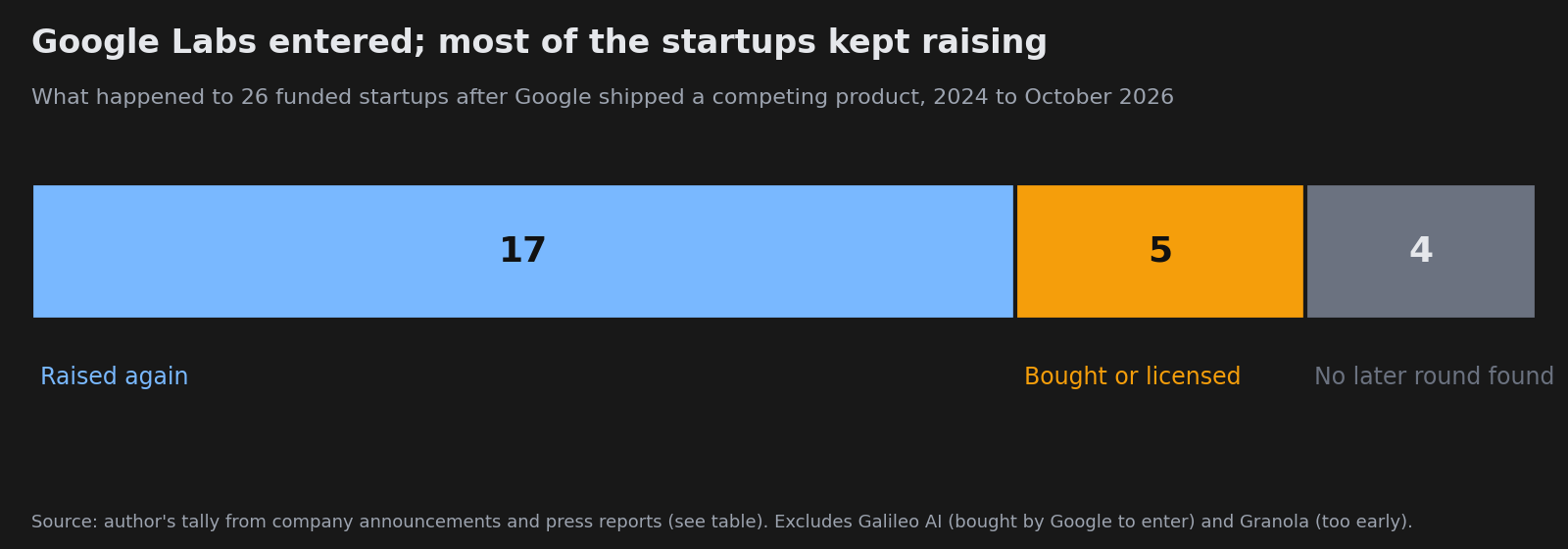
If free Google apps killed startups, it would show in the categories Google Labs has already entered. I counted 26 funded startups:
| Google product | Startups in the category | After Google entered |
|---|---|---|
| NotebookLM | Mem, Wondercraft | No later round found |
| VideoFX, now Flow | Luma, Runway, Higgsfield, Pika | All four raised |
| ImageFX, Whisk | Ideogram, Leonardo.Ai | Ideogram raised; Leonardo sold to Canva |
| MusicFX | Suno, ElevenLabs, Riffusion, Udio | Two raised; Google bought Riffusion; no later Udio round found |
| Stitch | Lovable, Vercel | Both raised |
| Jules | Cursor, Cognition, Replit, Factory, Windsurf | Four raised; Google licensed Windsurf |
| Opal | Gumloop | Raised |
| Project Mariner | Browserbase, Perplexity, The Browser Company | Two raised; one sold to Atlassian |
| Doppl | Daydream | No later round found |
| Mixboard | Visual Electric | Team bought by Perplexity |
| AI Edge dictation app | Wispr | Raised |
The tally excludes Galileo AI, which Google bought in order to launch Stitch, and Granola, which raised before Foresight existed. Sources are listed at the end of the post.
The base rate matters here. 2024 to 2026 was a funding boom, and follow-on rounds were common for any well-funded AI startup. I do not have a clean comparison group, so the tally cannot show that Google’s entry helped anyone. It weakens the strong claim that entry is lethal: had investors expected that, fewer of the seventeen would have raised. My list also leans toward startups visible enough to name, which biases it toward survivors.
Two other patterns stand out. Google buys what it wants: Galileo AI became Stitch, Riffusion became Flow Music, and Windsurf’s technology and CEO came over in a $2.4 billion licensing deal. And Google retires its own experiments quickly: in 2026 it folded or shut Whisk, ImageFX, Doppl, Project Mariner and MusicFX, mostly by moving their features into Gemini, Chrome and Search. The one clear Labs win, NotebookLM, now carries the Gemini brand with more than 30 million users (Google).
The research on platform entry points the same way, with a warning: when Google was more likely to enter an app category, developers cut innovation on the threatened apps and moved their effort to new ones (Wen and Zhu, Strategic Management Journal, 2019).
How I would test this
Both claims make predictions that card-level spend data, like Ramp’s, could check within a quarter:
- Defaults and routers. On September 22 Anthropic said Opus 5.5 matches Fable on most work at 40% of the price. If defaults decide the bill, Fable’s share of tokens should barely move at firms that buy straight from the lab, and should fall at firms that also pay a routing platform, comparing firms with similar Fable shares and trends before September 22.
- Free lab features. Gemini began taking meeting notes for consumer AI Pro and Ultra subscribers in mid-2026 (WinBuzzer), and Foresight arrived this week. If free features hurt thin products, notetaker spend at firms buying one or two seats should fall after those dates relative to firms buying team plans. An event study on the two groups, after checking that they trended alike beforehand, would separate the effect from the category’s growth.
If Fable’s share falls just as fast at firms that buy straight from the lab, my router claim is wrong. If small-seat notetaker spend holds up, my free-app claim is wrong. I will report either result here.
Who survives
Google’s free apps will kill far fewer startups than I first thought. What dies is a narrow kind of company: one whose margin is a markup on someone else’s tokens, for a feature a single user can run alone. Transcribe-and-summarize is now free, private and local, and any startup selling only that should expect its price to go to zero.
What survives owns something a bundle cannot give away: the team’s shared history, the workflow and system of record (Cursor, Lovable and Harvey all sit on the work itself), or a seat across models that also holds the buyer’s billing, evaluations or usage history. Granola’s March round was pitched on exactly that kind of enterprise context.
For a founder, the test is this: if a frontier lab shipped your core feature free tomorrow, what would your customers still pay you for? For notetakers, that day came this week.
FAQ
What is Google AI Edge Foresight? A free meeting notetaker for Mac from Google AI Edge, released in the first week of October 2026. It transcribes meetings, expands shorthand notes and answers questions from your own documents, all on the device.
Why don’t AI labs route simple prompts to cheaper models? They do where they pay for the compute, as in flat-fee chat subscriptions. Where the customer pays per token, the price menu and the default model decide the bill, and the overspend is the lab’s revenue. A lab also cannot route you to a rival’s cheaper model.
Does Google Labs kill the startups it competes with? Not on the record so far. Of 26 funded startups I mapped against Google Labs and Google AI Edge products, 17 raised again after Google entered, 5 were bought or licensed, and for 4 I found no later funding. Without a base rate, that weakens the claim that Google’s entry is lethal, and shows little more.
Which AI startups are most at risk from frontier labs? Startups whose margin is a markup on someone else’s tokens for a feature a single user can run alone, such as transcribe-and-summarize. Startups that own a team workflow, a system of record or a cross-model seat that holds the buyer’s billing or evaluations are better placed.
Sources for the startup table. Video: Pika (Jun 2024), Luma (Nov 2025), Runway (Feb 2026), Higgsfield (Aug 2026). Images: Ideogram (Feb 28, 2024, four weeks after ImageFX); Leonardo sold to Canva (Jul 2024). Music: Suno (Nov 2025, Jun 2026), ElevenLabs (Feb 2026), ProducerAI, formerly Riffusion (Feb 2026). Design: Lovable (Aug 2026), Vercel (Sep 2025). Coding: Cursor (Nov 2025), Cognition (May 2026), Replit (Mar 2026), Factory (Sep 2026), Windsurf (Jul 2025). Agents and browsers: Gumloop (Mar 2026), Browserbase (Jun 2025), Perplexity (Sep 2025), The Browser Company (Sep 2025), Visual Electric (Oct 2025). Dictation: Wispr (Aug 2026). Shutdowns: Killed by Google.