ICHRA After the Subsidy Cliff: Who Is Building, Who Left, and Why the Risk Mix Matters
A market-sizing, risk-pool, and competitive-posture analysis across seven national payers and the regional Blues, 2026–2030
Conventions & Method. Figures are as reported by the cited primary source (Q1 2026 Form 10-Q and FY2025 Form 10-K SEC filings, CMS Public Use Files, IRS guidance, KFF, RWJF, EBRI, and the HRA Council). Judgment marks analytical synthesis rather than reported fact. Dates are U.S. Eastern as of June 15, 2026. Companion piece: Impact of the One Big Beautiful Bill Act (OBBBA).
1. Executive Summary (The 90-Second Read)
| Strategic Metric | 2026 Baseline / Reported Benchmark | Strategic Implication for Payers & PBMs |
|---|---|---|
| 2026 ICHRA Market Size | 500K–700K covered lives (~0.5% of ~95M addressable pool; HRA Council 500K+ floor, EBRI 350K–700K, RWJF/HealthSherpa 400K–800K, ~80% off-exchange) | Still sub-scale for national balance sheets today, but scaling ~2.8x YoY in 2026 (BenefitsPRO) toward 2.35M lives by 2030 (Base case; range 1.50M–5.24M). |
| 2026 ACA Pool Shock | +26% avg. gross rate hike / +114% net OOP jump (KFF); Centene Q1’26 Marketplace down -36.4% YoY (5.63M → 3.58M) | ACA risk adjustment claws back raw morbidity gains; carriers prize ICHRA lives for payroll-funded persistency (>92% group renewal) and richer metal mix (60% Gold/Silver), not raw morbidity margin. |
| 2027 ALE Affordability Squeeze | 9.96% IRS affordability cap in 2026 (up from 9.02% in 2025); look-back safe harbor transmits 2026’s +26% ACA rate spike into 2027 employer renewal budgets | Creates a two-speed market: employee subsidy loss + IRS Notice 2026-05 Bronze-HSA eligibility accelerate take-up, while 2026 exchange rate inflation acts as a brake on 2027 large-group (ALE) conversions. |
| Payer & PBM Value Capture | Aetna exited ACA 1/1/2026 (~1M lives, $448M PDR); Cigna exits 1/1/2027 (369K lives); UHC & Elevance quietly build defensive off-exchange shelves | Owning top-3 PBMs and clinics did not save ACA underwriting—but opens an off-balance-sheet “side-door” play to monetize ICHRA via PBM/specialty contracting and retail-clinic co-branding without single-risk-pool volatility. |
Strategic Lens for Diversified Payer-PBMs (The CVS Health / Aetna Question): Exiting retail ACA underwriting on January 1, 2026 insulated CVS Health from single-risk-pool morbidity volatility after a $448M premium deficiency reserve in 2025. However, as ICHRA scales toward 2.35M lives by 2030, diversified payer-PBMs face a two-part strategic equation:
- Commercial Book Defense: Protect the 2.46M Insured Commercial group book (and 15.87M ASC self-funded lives against class-based carve-outs of part-time, seasonal, or out-of-area cohorts) using Level-Funded stop-loss and capital-light TPA administration.
- Off-Balance-Sheet Enterprise Offense (“The Side-Door Play”): Capture pharmacy and care-delivery margin from ICHRA growth without underwriting the ACA risk pool by (a) selling CVS Caremark / CVS Specialty formulary and rebate rails to non-integrated ICHRA carriers and regional Blues (mirroring Express Scripts’ contract powering Centene’s 26.2M lives), and (b) co-branding MinuteClinic, Oak Street Health, and CVS Pharmacy as the $0-copay primary-care front door for partner carriers’ off-exchange ICHRA plans (mirroring the co-branded Hy-Vee Health with Oscar ICHRA blueprint launched in Des Moines for 2026).
Five Core Theses
- ICHRA is real, growing fast, and still under 1% of its addressable pool.
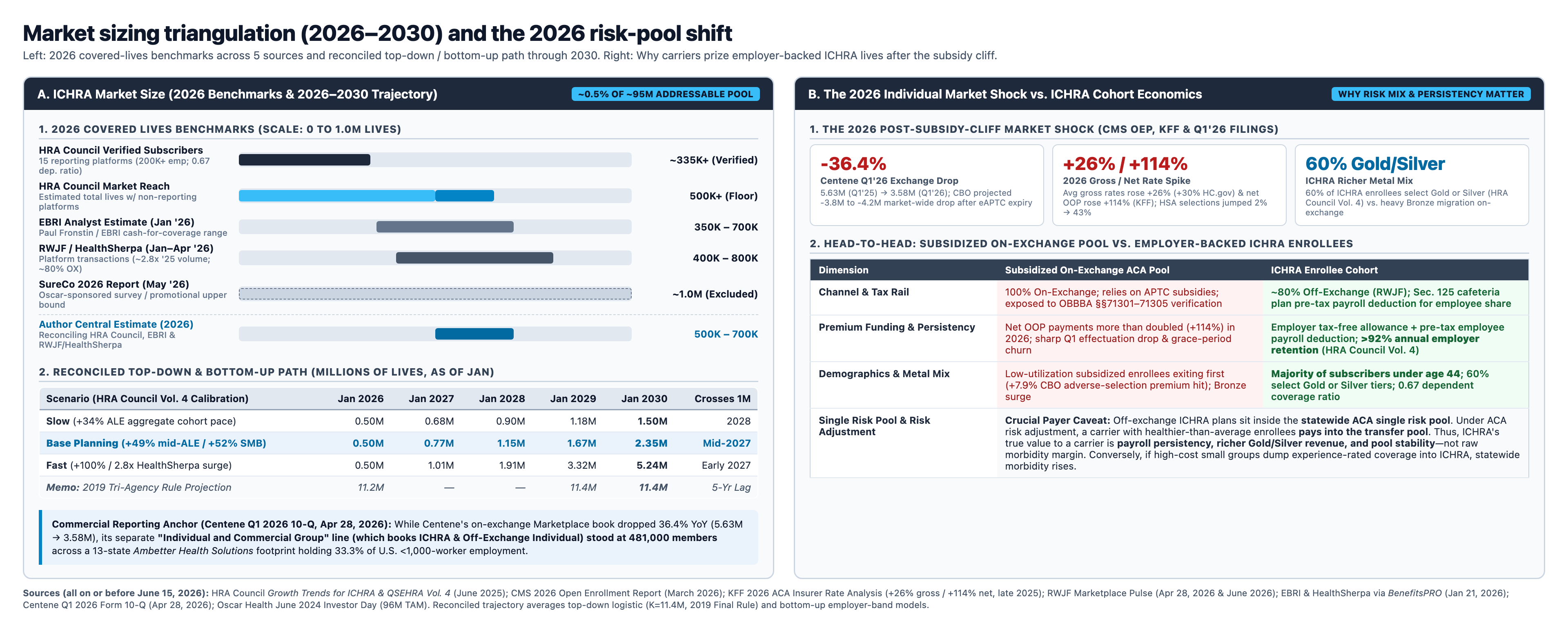
- 2026 level: Published 2026 estimates span 350,000–800,000 covered lives: 200,000+ participating employees across 15 reporting platforms (with a 0.67 dependent coverage ratio) and a 500,000+ market-wide covered-lives floor across ICHRA and QSEHRA (HRA Council Vol. 4, June 2025); 350,000–700,000 covered lives (EBRI / BenefitsPRO, Jan 21, 2026); and 400,000–800,000 enrollees (~2.8x 2025 volume), with ~80% enrolled off-exchange (RWJF, Apr 28, 2026).
- Central 2026 estimate (judgment): 500,000–700,000 covered lives (~0.5%–0.7% of an estimated ~95M-life addressable pool across firms under 1,000 employees and class-based carve-outs at 1,000+ employers, aligning with Oscar Health’s 96M TAM framing).
- Reconciled 2026–2030 trajectory (judgment): Averaging top-down logistic and bottom-up employer-band models calibrated to HRA Council growth cohorts puts national ICHRA lives at 0.77M by Jan 2027, crossing 1.0M in mid-2027, and reaching 2.35M by Jan 2030 in the Base planning case (range: 1.50M Slow to 5.24M Fast).
- The ACA individual market that ICHRA feeds contracted sharply and got sicker in 2026—making employer-backed ICHRA lives prized for persistency and metal mix, not raw morbidity margin.
- After enhanced premium tax credits (eAPTCs) expired on December 31, 2025, gross exchange benchmark premiums rose +26% on average (+30% on HealthCare.gov) and average net out-of-pocket payments jumped +114% (KFF). While 2026 Open Enrollment plan selections dipped 5% to 23.1M (CMS 2026 OEP Report, Mar 2026), Q1 2026 effectuated carrier books contracted dramatically once higher bills came due—led by Centene’s 36.4% YoY Marketplace drop from 5.63M (Q1 2025) to 3.58M (Q1 2026) (Centene Q1 2026 10-Q, Apr 28, 2026).
- The risk-adjustment caveat (judgment): Because off-exchange ACA plans sit inside the statewide single risk pool, ACA risk adjustment transfers away most of any single carrier’s morbidity advantage. Carriers prize ICHRA enrollees for three structural reasons that risk adjustment does not claw back: (i) payroll-funded persistency (>92% annual employer retention and near-100% effectuation), (ii) a richer metal mix (60% selecting Gold or Silver in ICHRA vs. heavy Bronze down-shifting on-exchange), and (iii) insulation from OBBBA verification attrition (§§71301–71305).
- Two opposing forces govern the 2027–2028 ramp: an employee subsidy-cliff tailwind vs. a large-employer (ALE) affordability squeeze.
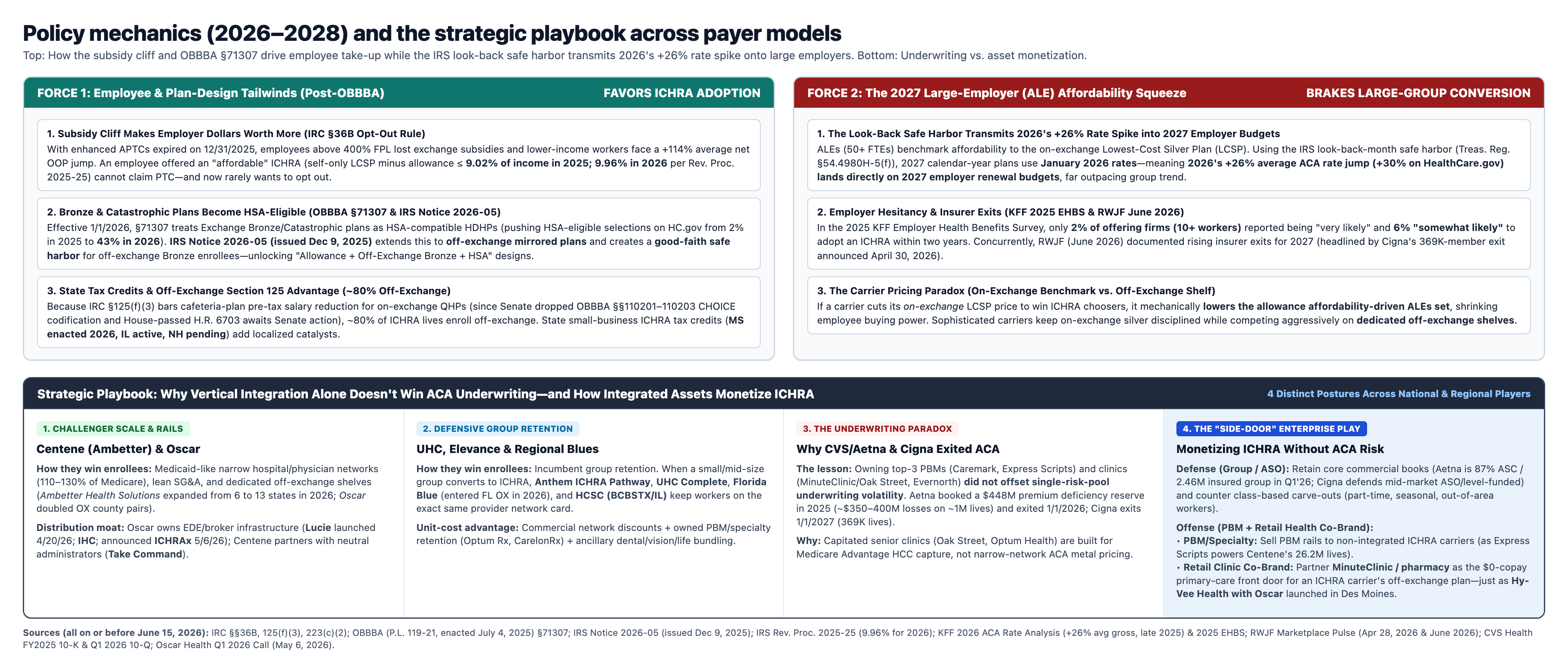
- Employee tailwind: Losing eAPTCs makes an employer’s tax-free ICHRA allowance far more valuable than opting out to claim reduced exchange subsidies. In parallel, OBBBA §71307 and IRS Notice 2026-05 (issued Dec 9, 2025) make on-exchange and mirrored off-exchange Bronze/Catastrophic plans HSA-eligible as of January 1, 2026—driving HSA-eligible selections on HealthCare.gov from 2% in 2025 to 43% in 2026.
- Employer headwind (the Slow-case mechanism): Applicable Large Employers (50+ FTEs) must fund allowances so the employee’s share of the on-exchange Lowest-Cost Silver Plan (LCSP) stays at or below 9.02% of household income in 2025 and 9.96% in 2026 (IRS Rev. Proc. 2025-25). Under the look-back-month safe harbor, 2027 calendar-year plans use January 2026 rates—meaning 2026’s +26% average ACA rate hike lands directly on 2027 employer renewal budgets.
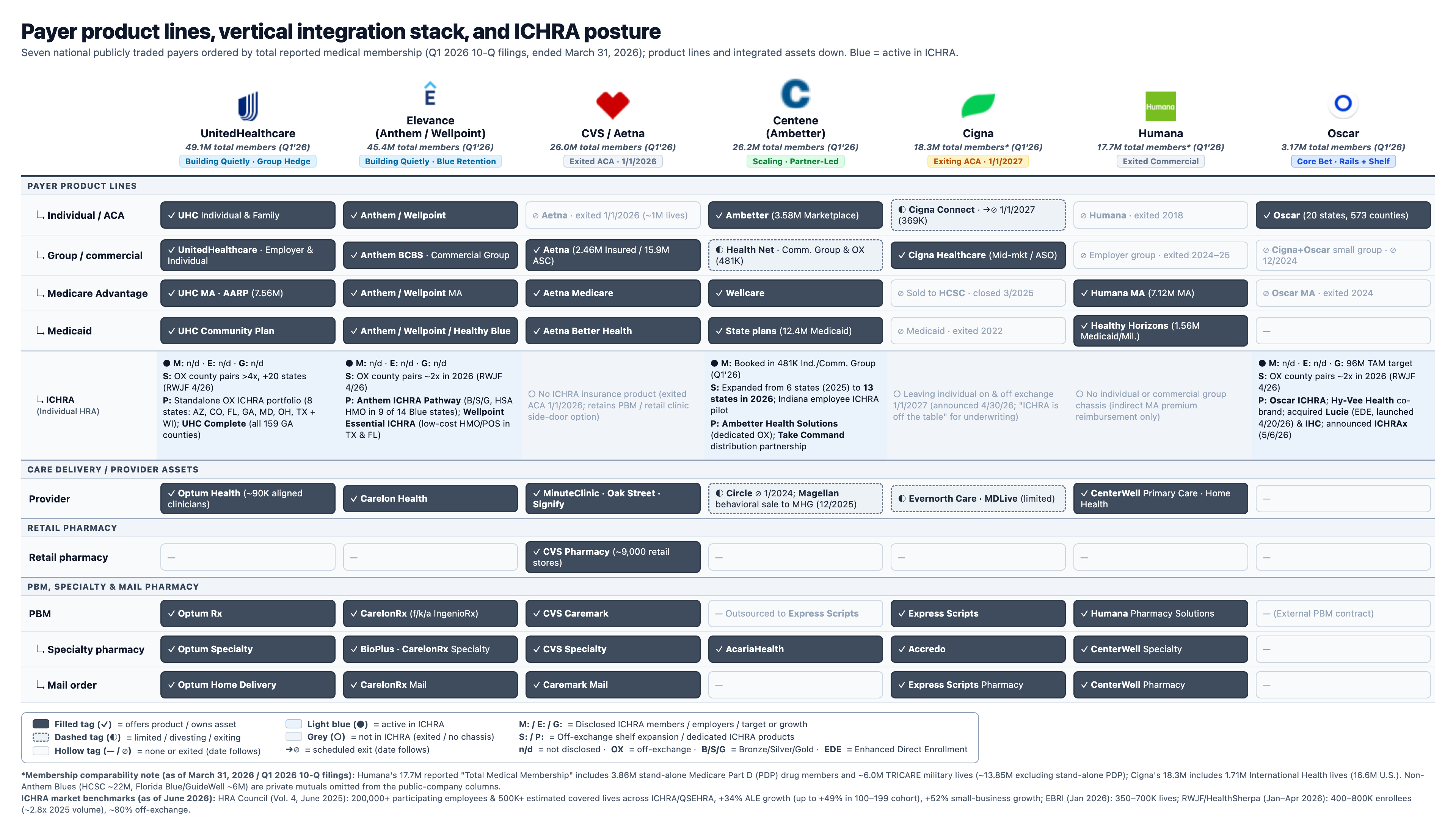
- The seven largest publicly traded payers—plus the regional Blues—have split into four strategic postures (as of Q1 2026 10-Q filings):
- Core growth bet (owning distribution rails + off-exchange shelf): Oscar Health (3.17M Q1’26 members; acquired CMS-approved EDE platform Lucie [launched Apr 20, 2026] and brokerage IHC Specialty Benefits; announced ICHRAx data exchange on May 6, 2026; doubled off-exchange county pairs).
- Scaling via partner platforms: Centene / Ambetter (26.2M total members; 3.58M Marketplace + 481,000 Individual & Commercial Group/ICHRA members; expanded Ambetter Health Solutions from 6 states in 2025 to 13 states in 2026 alongside Take Command).
- Building quietly (defensive group retention): UnitedHealthcare (49.1M members; >4x off-exchange county pairs, +20 states; UHC Complete across all 159 GA counties), Elevance (45.4M members; ~2x off-exchange county pairs; Anthem ICHRA Pathway in 9 of 14 Blue states; Wellpoint Essential ICHRA in TX and FL), and dominant non-Anthem Blues (Florida Blue/GuideWell, HCSC in TX/IL/OK).
- Exited individual underwriting: CVS / Aetna (26.0M members; exited ACA 1/1/2026 across 17 states, ~1M members, after a $448M premium deficiency reserve), Cigna (18.3M members; announced on April 30, 2026 its exit from all 11 ACA states effective 1/1/2027, 369K members), and Humana (17.7M reported members / 13.85M ex-PDP; exited individual in 2018 and employer group in 2024–25).
- The integration paradox—and the “side-door” play for CVS Health and Evernorth (judgment).
- Owning top-three PBMs, specialty pharmacies, and care-delivery clinics did not offset single-risk-pool underwriting volatility for CVS/Aetna or Cigna, whereas non-integrated Centene and Oscar win ACA enrollment via Medicaid-like narrow hospital/physician networks (110–130% of Medicare) and broker/EDE distribution.
- Where vertical integration wins: For active underwriters (UHC, Elevance), owned PBMs (Optum Rx, CarelonRx) retain intercompany pharmacy margin as group lives convert. For exited underwriters (CVS Health, Cigna), integrated assets open an off-balance-sheet “side-door” play: monetizing ICHRA growth without ACA underwriting exposure by (a) selling PBM and specialty-pharmacy rails to ICHRA carriers and (b) co-branding retail-health clinics (MinuteClinic, Oak Street) as the $0-copay primary-care front door for partner carriers’ ICHRA plans.
2. What ICHRA Is—and How the Mechanics Drive Market Behavior
- Regulatory origin: The June 2019 tri-agency final rule (Treasury, DOL, HHS; 84 FR 28888) established the Individual Coverage HRA for plan years beginning on or after January 1, 2020. House-passed reconciliation language in 2025 (H.R. 1 §§110201–110203) and standalone House legislation (H.R. 6703, passed December 17, 2025) proposed renaming and codifying ICHRA as a “CHOICE Arrangement” (Custom Health Option and Individual Care Expense), though the Senate stripped those provisions from the enacted One Big Beautiful Bill Act (P.L. 119-21).
- Core mechanics and class segmentation:
- An employer of any size funds a tax-free monthly allowance (under IRC §§105 and 106) that reimburses employees for individual-market health insurance premiums purchased on- or off-exchange.
- Allowances can vary by age (up to a 3:1 ratio, matching ACA individual age bands), family size, and permitted employee classes (full-time, part-time, seasonal, hourly, salaried, collective-bargaining, or geographic rating area).
- Minimum class-size anti-dumping guardrails: If an employer offers a traditional group plan to one class (e.g., salaried headquarters staff) and an ICHRA to another class (e.g., hourly or part-time workers), minimum class-size rules apply to classes that could be used to segment health risk: 10 employees for firms with <100 workers, 10% of the workforce for firms with 100–200 workers, and 20 employees for firms with >200 workers (no minimum applies to the geographic rating-area class or when no traditional group plan is offered).
- The IRC §36B affordability test and Premium Tax Credit (PTC) opt-out rule:
- Under IRC §36B(c)(2)(C) and Treas. Reg. §1.36B-2(c)(5), an employee offered an affordable ICHRA is ineligible for the federal Premium Tax Credit (PTC) on the Exchange—even if the employee waives the ICHRA.
- How affordability is tested: An ICHRA is affordable if the monthly premium for the self-only lowest-cost Silver plan (LCSP) available on the Exchange in the employee’s rating area (for the employee’s age), minus the employer’s monthly self-only ICHRA allowance, does not exceed the IRS indexed required-contribution percentage of household income: 9.02% in 2025 (Rev. Proc. 2024-35) and 9.96% in 2026 (Rev. Proc. 2025-25).
- Offering an affordable ICHRA also satisfies the ACA §4980H(a) and (b) employer mandate for Applicable Large Employers (ALEs, 50+ FTEs). ALEs may use W-2, rate-of-pay, or federal poverty line safe harbors, plus the worksite-location and look-back-month safe harbors (Treas. Reg. §54.4980H-5(f)).
- If the ICHRA offer is unaffordable, the employee may affirmatively opt out (waive) the ICHRA prior to the plan year and claim the PTC on the Exchange.
- Why ~80% of ICHRA enrollment is off-exchange (the IRC §125 cafeteria-plan rule):
- Most employees pay a portion of their premium above the employer’s allowance (“flexing up” for Silver or Gold coverage).
- Under IRC §125(f)(3), an employer cannot allow employees to pay their remaining share of the premium pre-tax through a Section 125 cafeteria plan if the policy is purchased on an ACA Exchange. For off-exchange ACA-compliant plans, pre-tax payroll deduction is permitted. That tax wedge is why roughly 80% of ICHRA enrollees buy off-exchange plans (CMS; RWJF, Apr 28, 2026).
- Comparison with QSEHRA and traditional group coverage:
- QSEHRA (created by the 21st Century Cures Act, Dec 2016; IRC §9831(d)) is statutory rather than regulatory, is restricted to non-ALEs (<50 FTEs) that do not offer any group plan, caps annual employer contributions ($6,350 single / $12,800 family in 2025; $6,450 single / $13,100 family in 2026), and reduces an employee’s PTC dollar-for-dollar rather than triggering a cliff opt-out.
- Traditional group vs. ICHRA: In a fully insured or self-funded (ASO/level-funded) group plan, the employer bears or pools the morbidity risk of its workforce. Under ICHRA, the employer shifts to a defined contribution and moves the clinical risk into the statewide ACA individual single risk pool (judgment).
3. Market Size (2026) and Reconciled Trajectory Through 2030
3.1 Triangulating the 2026 Baseline
Public ICHRA sizing figures frequently conflate ICHRA-only vs. ICHRA+QSEHRA, offered lives vs. enrolled lives, and reporting-vendor samples vs. whole-market extrapolations. Aligning each source published on or before June 15, 2026 to a consistent definition produces a clean baseline:
| Source (As-Of Date) | Exact Measure & Scope | Reported / Derived Figure | Methodological Assessment |
|---|---|---|---|
| HRA Council Vol. 4 (Published June 2025) | Aggregated anonymized data from 15 reporting HRA platforms plus market-wide reach estimate | • 200,000+ participating employees across reporting platforms (0.67 dependent coverage ratio ≈ 335,000+ verified covered lives) • 500,000+ total covered lives market-wide reach across ICHRA & QSEHRA • +34% YoY aggregated ALE growth (up to +49% in 100–199 employee cohort) and +52% small-business ICHRA growth among founding platforms |
Foundational cohort benchmark. Documents 83% net-new offering rate (previously uninsured firms), >92% annual employer retention, and 60% Gold/Silver plan selection (HRA Council). |
| RWJF / HealthSherpa (Jan–Apr 2026) | Nationwide ICHRA enrollees using platform transaction data | 400,000–800,000 enrollees; ~80% off-exchange; 2026 volume ~2.8x 2025 (BenefitsPRO, Jan 21, 2026; RWJF, Apr 28, 2026) | Primary 2026 OEP cross-check. Extrapolated by HealthSherpa SVP Michael Levin from enrollment transactions (~1/3 of ACA volume). |
| EBRI (Jan 2026) | Workers and dependents in formal individual coverage HRAs | 350,000–700,000 covered lives (Paul Fronstin, EBRI, via BenefitsPRO, Jan 21, 2026) | Consistent independent range. Brackets the HRA Council’s 500K+ benchmark and RWJF/HealthSherpa’s 400K–800K range. |
| SureCo 2026 State of ICHRA (May 2026) | Estimated covered lives (Oscar Health–sponsored report) | ~1,000,000 covered lives (SureCo PDF, May 2026) | Excluded from central range as a promotional, vendor-sponsored upper bound (and likely blends QSEHRA or offered lives). |
| Centene Q1 2026 10-Q (Ended Mar 31, 2026; filed Apr 28, 2026) | Commercial segment reporting lines (Marketplace vs. Individual and Commercial Group) | • 3.58M Marketplace members (down 36.4% YoY from 5.63M in Q1 2025) • 481,000 Individual and Commercial Group members (the reporting line where Centene books Commercial Group, ICHRA, and Other Off-Exchange Individual; 4.06M total Commercial) |
Key SEC accounting clarification. Centene books off-exchange ICHRA (Ambetter Health Solutions, active in 13 states in 2026) inside its 481K Individual & Commercial Group line, not its 3.58M on-exchange Marketplace line. |
| Oscar Health Filings & Calls (June 2024 Investor Day; FY25 10-K; Q1’26 Call May 6, 2026) | Addressable market sizing & 2026 strategic infrastructure | Frames a 96M-life addressable market across small and mid-sized employers (<1,000 workers); total effectuated ACA membership reached 3.17M in Q1 2026 (+56% YoY); launched Lucie (Apr 20, 2026) and announced ICHRAx (May 6, 2026) | Strategic corroboration. Confirms pure-play ACA carrier focus on capturing small/mid-group migration via owned EDE and broker rails. |
- Why the draft’s “~310K floor” method should be retired—and what replaces it (judgment):
- Dividing a single carrier’s off-exchange ICHRA book by its on-exchange Marketplace book and multiplying by KFF’s prior-year on-exchange total mixes incompatible denominators (80% of ICHRA lives are off-exchange, and Centene’s Q1 2026 10-Q explicitly books ICHRA inside its 481,000 Individual and Commercial Group line rather than its 3.58M Marketplace line).
- Instead, anchoring directly on the HRA Council’s 200,000+ verified participating employees (~335,000+ verified covered lives at a 0.67 dependent ratio) and 500,000+ market-wide floor, cross-checked against EBRI (350K–700K) and RWJF/HealthSherpa (400K–800K), yields a rigorous 2026 central estimate of 500,000–700,000 covered lives.
- Context against the 2019 federal projection: The 2019 Final Rule’s Treasury microsimulation projected 11.2M ICHRA lives by 2026 and 11.4M by 2029 across 800,000 firms (84 FR 28966, Table 2). Actual 2026 adoption (~0.5M–0.7M lives) sits at ~4.5–6% of the initial federal projection—a 5-year lag caused by the pandemic, enhanced ACA subsidies (2021–2025), and broker commission inertia.
3.2 Reconciled 2026–2030 Growth Path: Why Pace Matters More Than the Ceiling
To project how fast ICHRA scales from its January 2026 baseline of 0.50M lives, I reconcile two parameterizations of the HRA Council’s cohort data against an estimated ~95M-life addressable pool (70.1M replacement lives + 13.4M previously uninsured “white space” lives at firms with <1,000 employees, plus 11.6M class-based carve-out lives at firms with 1,000+ employees, derived from 2022 Census SUSB and 2025 KFF EHBS):
- Top-Down (TD) Logistic Path: Runs from
0.50M(Jan 2026) toward the 2019 rule’s11.4Msteady-state level, with intrinsic growth rate $r$ calibrated to three observed industry growth regimes: Slow ($r=0.31$, +34% HRA Council Vol. 4 aggregate ALE growth), Base ($r=0.44$, +49–52% HRA Council core cohort growth), and Fast ($r=0.74$, +100% / HealthSherpa’s 2.8x 2026 surge pace with gradual maturation). - Bottom-Up (BU) Employer-Size Cohort Path: Separates non-ALE small businesses (<50 workers, where 83% of HRA adopters previously offered no coverage) from ALEs (50+ workers, where average covered lives per employer are an order of magnitude larger) and applies cohort-specific net growth rates with gradual maturation fade through 2030.
| Scenario | Calibration Basis (HRA Council Vol. 4 & HealthSherpa) | Jan 2026 | Jan 2027 | Jan 2028 | Jan 2029 | Jan 2030 (Planning) | 2030 TD / BU Split | Crosses 1M Lives |
|---|---|---|---|---|---|---|---|---|
| Slow | +34% ALE aggregate cohort pace; 2027 look-back affordability brake bites hard | 0.50M | 0.68M | 0.90M | 1.18M | 1.50M | 1.56M / 1.44M | 2028 |
| Base (Planning) | +49% mid-size ALE / +52% founding-platform SMB growth pace | 0.50M | 0.77M | 1.15M | 1.67M | 2.35M | 2.40M / 2.30M | Mid-2027 |
| Fast | +100% sustained surge (following HealthSherpa’s 2.8x OEP 2026 jump) | 0.50M | 1.01M | 1.91M | 3.32M | 5.24M | 5.35M / 5.13M | Early 2027 |
- Key modeling insight (judgment): Through 2030, even the Fast case reaches less than half of the 11.4M assumed ceiling (and ~5.5% of the 95M addressable pool). Varying the long-run ceiling between 8M and 15M moves the 2030 Base estimate by only ±0.07M lives (2.27M–2.40M), whereas varying the near-term adoption growth rate by ±20% swings 2030 lives by 1.34M (1.75M–3.09M). Through 2030, adoption velocity—governed by individual-market vs. group rate differentials—drives the market, not the TAM ceiling.
4. Why Carriers Care: Risk Mix, Single-Risk-Pool Mechanics, and the 2026 Market Shock
4.1 The 2026 Post-Subsidy-Cliff Contraction and Morbidity Spike
- Rate shock and effectuated contraction: Following the December 31, 2025 expiration of enhanced premium tax credits (eAPTCs), insurers raised gross exchange benchmark premiums by an average of +26% for 2026 (+30% in HealthCare.gov states), while average net out-of-pocket premiums after reduced subsidies jumped +114% (KFF). CBO projected that the eAPTC expiration would reduce marketplace coverage by ~3.8M–4.2M lives and add +7.9% to gross benchmark premiums through adverse selection.
- What Q1 2026 filings show: While plan selections at the close of the 2026 Open Enrollment Period dipped 5% to 23.1M (CMS 2026 OEP Report, Mar 2026), Q1 2026 effectuated carrier books fell sharply once higher net invoices came due:
- Centene’sACA Marketplace membership fell 36.4% YoY, from 5.63M as of March 31, 2025 to 3.58M as of March 31, 2026 (Centene Q1 2026 10-Q, Apr 28, 2026).
- CVS/Aetna exited the individual exchange entirely on January 1, 2026 (~1.0M members across 17 states).
- UnitedHealthcare guided to a >500,000-member exchange contraction in 2026 after raising rates to recover margins (UNH Q4 2025 call, Jan 27, 2026).
- Cigna announced on April 30, 2026 that it will exit the ACA individual market across all 11 of its states (369,000 members) effective January 1, 2027 (STAT, Apr 30, 2026), part of a broader wave of 2027 insurer exits documented by RWJF in June 2026.
- OBBBA’s Marketplace verification provisions (P.L. 119-21, enacted July 4, 2025) add further attrition pressure to the subsidized on-exchange pool:
- §71304 (effective 2026): Eliminates APTC eligibility for enrollees entering via low-income Special Enrollment Periods (SEPs).
- §71305 (effective TY2026): Repeals statutory repayment caps on excess advance premium tax credits, requiring 100% reconciliation repayment.
- §71301 (effective TY2027): Restricts PTC eligibility for certain lawfully present immigrants.
- §71303 (effective TY2028): Mandates pre-enrollment eligibility verification, ending passive auto-reenrollment with APTC.
4.2 The Nuanced Risk-Mix Argument: What ACA Risk Adjustment Claws Back—and What It Doesn’t (Judgment)
A naive thesis holds that ICHRA enrollees are healthier, employed workers who automatically boost a carrier’s underwriting margin. Payer economics are more subtle, for three reasons:
- ACA Risk Adjustment Claws Back Raw Morbidity Gains:
- Off-exchange ACA-compliant plans (where ~80% of ICHRA members enroll) are legally part of the same statewide ACA single risk pool as on-exchange plans.
- Because age is already priced on the 3:1 rate curve and diagnosis-based morbidity is equalized across carriers via the statewide risk-adjustment transfer formula, attracting a healthier-than-average 32-year-old ICHRA member produces a lower risk score and requires the carrier to pay into the state risk-adjustment transfer pool.
- Why carriers cannot simply underprice ICHRA plans for lower morbidity: Under HHS single-risk-pool rating rules (45 CFR §156.80), an insurer’s plan-level Actuarial Value and Cost-Sharing Design (
AV/CSR) factor and Induced Demand Factor (IDF) ($1.00$ for Bronze, $1.03$ for Silver, $1.08$ for Gold, $1.15$ for Platinum) are strictly barred from reflecting enrollee health status or morbidity. All morbidity differences are pooled across the issuer’s entire statewide individual book via the market-wide Risk Pool / Exchange User Fee & Morbidity Adjustment (RSF) and equalized across issuers via HHS risk adjustment.
- What Risk Adjustment Does Not Claw Back (Why Carriers Still Prize ICHRA Lives):
- Payroll-funded effectuation and 12-month persistency: Subsidized exchange enrollees who drop coverage when net premiums rise—or who fail income/SEP verification—are disproportionately healthy, low-utilization members whose mid-year exit degrades the remaining pool and creates grace-period bad debt. ICHRA premiums are funded by employer allowances and pre-tax payroll deductions, backed by >92% annual employer retention (HRA Council Vol. 4).
- A richer metal mix and higher gross unit revenue: Per the HRA Council’s Volume 4 data, 60% of ICHRA enrollees select Gold or Silver coverage, whereas public exchange enrollees shifted heavily toward Bronze in 2026 (driving HSA-eligible selections on HealthCare.gov from 2% to 43%). Higher Gold and Silver selection increases gross premium revenue per member and gives carriers greater absolute dollar margin under the 80% ACA Medical Loss Ratio (MLR) ceiling.
- Younger working-age base stabilizing the statewide pool: The majority of ICHRA primary subscribers are under age 44, with a 0.67 dependent coverage ratio (HRA Council Vol. 4). Even after inter-carrier risk transfers, adding employed, continuously enrolled working-age families dampens statewide single-risk-pool premium spirals.
- The Actuary’s Counter-Risk: Adverse Selection (“Risk Dumping”) from Experience-Rated and Level-Funded Groups:
- Healthy small and mid-sized employers can already exit the ACA small-group pool into level-funded or self-insured stop-loss arrangements. Which employers have the strongest financial incentive to drop group coverage and convert to an ICHRA? Groups facing 25–50% renewal shocks due to older demographics or high-cost claimants—because the individual market cannot experience-rate a sick group and caps age rating at 3:1 (whereas medical claim costs slope ~5:1 by age).
- Whether net ICHRA inflows improve or worsen statewide individual morbidity depends on the balance between white-space small firms (83% of HRA adopters in Vol. 4 previously offered no coverage) and distressed group conversions—a split that has not yet been measured in claims data (RWJF, Apr 28, 2026).
5. Carrier Strategies: Reading Figure 1 Across the Seven National Payers and Regional Blues
Figure 1 maps the seven largest publicly traded U.S. health insurers (ordered by Q1 2026 Form 10-Q reported membership as of March 31, 2026) across their payer product lines, ICHRA shelf and disclosures, and vertical integration stack (care delivery, retail pharmacy, PBM, specialty, and mail pharmacy).
5.1 UnitedHealthcare: 49.1M Members (Q1 2026) · Building Quietly (Defensive Group Hedge)
- ICHRA shelf & expansion: Offers a standalone off-exchange ICHRA portfolio across 8 states in 2026 (
AZ, CO, FL, GA, MD, OH, TXin 2025, addingWIfor 2026; UHC PY2026 ICHRA 101 Flyer). In Georgia, UHC launched UHC Complete, offering broad-network off-exchange plans across all 159 counties because “Georgia is ripe for ICHRA due to individual rates being lower than small group.” Across its broader individual book, UHC more than quadrupled its off-exchange county participation pairs and entered 20 new states for 2026 (RWJF, Apr 28, 2026). - Disclosures: Zero ICHRA membership or revenue figures disclosed; management guided to a >500K contraction in on-exchange membership for 2026 (Q4 2025 call, Jan 27, 2026).
- Integrated stack: Full clinical and pharmacy ownership via Optum Health (~90K aligned clinicians), Optum Rx, Optum Specialty, and Optum Home Delivery (no retail pharmacy).
- Strategic read (judgment): A quiet defensive hedge protecting the nation’s largest commercial employer book, retaining converting small-group accounts inside UHC networks and Optum Rx pharmacy rails without promoting group-to-individual cannibalization.
5.2 Elevance Health (Anthem / Wellpoint): 45.4M Members (Q1 2026) · Building Quietly (Blue Network Retention)
- ICHRA shelf & expansion: Offers Anthem ICHRA Pathway plans (Bronze, Silver, Gold, including HSA-eligible HMO designs) across 9 of its 14 Blue states (
CO, GA, IN, KY, MO, NV, NH, OH, WI; Remodel Health, Dec 2025), plus Wellpoint Essential ICHRA low-cost HMO/POS tiers in non-Blue expansion markets Texas (Wellpoint Insurance Co. SBC) and Florida (Simply Healthcare Plans d/b/a Wellpoint Florida). Overall off-exchange county participation pairs roughly doubled in 2026 (RWJF, Apr 28, 2026). - Disclosures: No standalone ICHRA member count disclosed on its Q1 2026 earnings call (April 22, 2026).
- Integrated stack: Carelon Health, CarelonRx (f/k/a IngenioRx), BioPlus / CarelonRx Specialty, and CarelonRx Mail.
- Strategic read (judgment): Keeps converting small/mid-size groups inside the Anthem Blue network and CarelonRx PBM in its 9 Blue states, while using Wellpoint Essential as an attacker brand in Texas and Florida.
5.3 CVS Health (Aetna): 26.0M Members (Q1 2026) · Exited ACA Underwriting (1/1/2026)
- ACA exit: Effective January 1, 2026, Aetna exited the individual ACA exchange business across all 17 states where it operated (~1M members), after booking a $448M premium deficiency reserve in Q1 2025 and projecting $350–$400M in 2025 individual-market losses (CVS Q1 2025 8-K; Healthcare Dive, May 1, 2025). CEO David Joyner stated there was “not a near- or long-term pathway for Aetna to materially improve its position.”
- Current commercial book: Following the ~1M exchange exit, Aetna’s 18.33M commercial medical book as of March 31, 2026 (
CVS Q1 2026 10-Q) is 87% ASC/self-funded (15.87M) and 13% insured group (2.46M, down from 3.45M at 12/31/2025). - Integrated stack: The most complete vertical stack in U.S. healthcare—and the only one with national retail pharmacy: MinuteClinic, Oak Street Health, Signify Health, CVS Pharmacy (~9,000 retail locations), CVS Caremark, CVS Specialty, and Caremark Mail.
- Strategic read (judgment): Having exited ACA underwriting, CVS faces a dual ICHRA mandate: defend its 2.46M insured group book (and self-funded accounts considering class carve-outs) while pursuing off-balance-sheet offense via Caremark PBM contracting and MinuteClinic retail-health co-branding (detailed in Section 5.9).
5.4 Centene (Ambetter): 26.2M Members (Q1 2026) · Scaling (Partner-Led; 6 → 13 States in 2026)
- ICHRA shelf & expansion: Launched Ambetter Health Solutions (dedicated off-exchange, ICHRA-compatible plans) in 6 states in 2025 and expanded to 13 states in 2026 (
AZ, FL, GA, IN, KS, MS, MO, NE, OH, OK, SC, TN, TX), distributing via neutral administrators including “Ambetter Health Business Solutions, Powered by Take Command” (PR Newswire). Note that across its broader individual book, Centene’s total off-exchange county pairs declined in 2026 due to portfolio recalibration (RWJF, Apr 28, 2026). Centene also launched an internal ICHRA pilot for its own Indiana workforce in 2026. - Disclosures & Q1 2026 Commercial structure: In its Q1 2026 earnings release and Form 10-Q (ended March 31, 2026; released April 28, 2026), Centene reported 3.58M Marketplace members (down 36.4% YoY from 5.63M in Q1 2025) and 481,000 Individual and Commercial Group members—the reporting line that explicitly includes Commercial Group, ICHRA, and Other Off-Exchange Individual (4.06M total Commercial lives). Centene’s 13 ICHRA states represent 33.3% of U.S. employment at firms with <1,000 workers per Census SUSB data.
- Integrated stack: Minimal vertical integration after multi-year divestitures. Centene completed the sale of U.K. hospital operator Circle Health Group to PureHealth in January 2024 (~$1.2B) and signed a definitive agreement in December 2025 to divest its remaining Magellan Behavioral Health business to Madison Health Group (MHG) (recording a $513M pre-tax impairment in Q4 2025; Magellan Rx and NIA were sold in 2022–23). Centene retains specialty pharmacy AcariaHealth and outsources its PBM to Cigna’s Express Scripts.
- Strategic read (judgment): The largest ACA chassis in the nation, competing on Medicaid-leveraged narrow-network pricing rather than owned care delivery or PBM integration.
5.5 Cigna: 18.3M Members (16.6M U.S., Q1 2026) · Exiting ACA Underwriting (1/1/2027)
- ACA & small-group exit: After shuttering its co-branded Cigna+Oscar small-group joint venture at year-end 2024, Cigna announced on April 30, 2026 (on its Q1 2026 earnings call) that it is exiting the ACA individual market (on- and off-exchange) effective January 1, 2027, affecting 369,000 members across 11 states (STAT, Apr 30, 2026; MedCity News, May 2026). President and COO Brian Evanko stated Cigna “did not see a clear path to scale this business to achieve meaningful impact.” Cigna also sold its Medicare Advantage business to HCSC (closed March 2025).
- Integrated stack: Express Scripts (PBM), Accredo (specialty pharmacy), Express Scripts Pharmacy (mail), and limited care delivery via Evernorth Care / MDLive.
- Strategic read (judgment): Cigna’s core commercial franchise is mid-market ASO (
14.13MU.S. ASO lives in Q1 2026) and level-funded stop-loss—the exact segment ICHRA targets. Cigna is choosing to defend group/ASO directly and monetize individual/ICHRA lives upstream through Evernorth / Express Scripts (including its PBM contract with Centene).
5.6 Humana: 17.7M Total Reported Members (13.85M ex-Stand-Alone PDP, Q1 2026) · Exited Commercial
- History & comparability note: Humana exited individual ACA coverage in 2018 and completed its exit from employer group commercial medical in 2024–25 (Humana, Feb 2023). Note that Humana’s
17,711.4Kreported “Total Medical Membership” as of March 31, 2026 includes 3.86M stand-alone Medicare Part D (PDP) drug plan members and ~6.0M TRICARE military lives (13.85M excluding stand-alone PDP;7.12MMedicare Advantage). - Current position: No commercial group or individual chassis; its only contact with ICHRA is indirect (employers may use an ICHRA to reimburse Medicare Part A/B/C/D or Medigap premiums for Medicare-eligible active workers).
5.7 Oscar Health: 3.17M Members (Q1 2026) · Core Bet (Owning Distribution Rails + Off-Exchange Shelf)
- Stated priority: Oscar exited Medicare Advantage and the Cigna+Oscar small-group JV at year-end 2024, declaring in its FY2025 10-K its goal to “position Oscar as the preferred carrier for employees enrolling in health insurance through an ICHRA program.” Effectuated membership reached 3,174,489 as of March 31, 2026 (+56% YoY from 2.04M in Q1 2025, across 20 states and 573 counties, heavily concentrated in FL, TX, and GA;
OSCR Q1 2026 10-Q). At its June 7, 2024 Investor Day, CEO Mark Bertolini framed ICHRA as expanding Oscar’s addressable market from ~21M ACA lives to 96M lives across employers with <1,000 workers. - Owning the distribution and enrollment rails:
- 2025 Acquisitions & April 2026 Storefront Launch: Acquired Lucie, Inc. (f/k/a INSXCloud, one of 11 CMS-approved Enhanced Direct Enrollment [EDE] platforms), IHC Specialty Benefits (brokerage), and Healthinsurance.org in May 2025. On April 20, 2026, Oscar officially launched the Lucie Health Marketplace as an AI-powered, carrier-agnostic digital storefront allowing consumers, brokers, and ICHRA employees to bundle ACA coverage with supplemental and ancillary plans (e.g., Aflac).
- ICHRAx Announcement (May 6, 2026): On Oscar’s Q1 2026 earnings call on May 6, 2026, CEO Mark Bertolini announced that Oscar collaborated to launch ICHRAx, a plug-and-play data exchange connecting carriers, brokers, and ICHRA administrative platforms to standardize fragmented off-exchange enrollment and billing (Becker’s, May 6, 2026; Q1 2026 Call Transcript). Neither ICHRAx’s formal corporate ownership structure nor rival carrier participation has been independently disclosed in SEC filings as of June 15, 2026.
- Shelf & retail co-brands: Roughly doubled off-exchange county participation in 2026 (RWJF, Apr 28, 2026) and launched the co-branded Hy-Vee Health with Oscar ICHRA plan in Des Moines, IA ($0 concierge primary care at Hy-Vee clinics; Fierce Healthcare).
- Integrated stack: None (zero owned provider clinics, retail/specialty pharmacy, or PBM).
5.8 The Missing Giants: Non-Anthem Regional Blues and CareSource
Because Figure 1 tracks publicly traded national carriers, it omits the private mutual Blue Cross Blue Shield plans and regional Medicaid/ACA insurers that lead the largest ICHRA states:
- Florida Blue (GuideWell): The #1 insurer in the nation’s largest ACA/ICHRA state (covering all 67 Florida counties). Per RWJF (April 28, 2026), GuideWell newly entered the off-exchange market in 2026, deploying BlueOptions PPO and myBlue HMO to defend small/mid-group accounts against Oscar (which holds 58% of its membership in Florida) and Ambetter.
- HCSC (BCBS of Texas, Illinois, Montana, New Mexico, Oklahoma): The 5th-largest U.S. health insurer (~22M members; acquired Cigna’s MA business in March 2025) and the market leader in Texas (#2 ACA/ICHRA state), Oklahoma, and Illinois (which offers a state small-business ICHRA tax credit).
- Dominant State Blues: BCBS of North Carolina, BCBS of Alabama, Highmark (PA), and Wellmark (IA) hold commanding commercial group and individual market share across key Southeast and Midwest states.
- CareSource: Highlighted alongside Elevance and Oscar by RWJF (April 28, 2026) for roughly doubling its off-exchange county participation in 2026 and entering Georgia off-exchange.
5.9 Re-Evaluating Vertical Integration: Why Owned Assets Didn’t Save ACA Underwriting—and How They Monetize ICHRA (Judgment)
A surface reading of the industry suggests that owning provider clinics and PBMs gives integrated giants (UHC, Elevance) a decisive unit-cost moat in ICHRA. The empirical record requires a sharper distinction between underwriting competitiveness and enterprise profit capture:
- Why vertical integration did not prevent CVS/Aetna and Cigna from exiting ACA underwriting:
- In the ACA individual market, benefits are standardized by metal tier, and price leadership is won through Medicaid-style narrow hospital and physician fee schedules (typically 110–130% of Medicare) and lean administrative technology—not owned primary-care clinics. Capitated senior-focused clinic models (Oak Street Health, Optum Health, CenterWell) are engineered to capture Medicare Advantage HCC risk scores and manage high-acuity seniors, not 32-year-old commercial Bronze/Silver enrollees.
- Meanwhile, non-integrated scale carriers (Centene, Oscar) can rent PBM scale externally (Centene contracts with Cigna’s Express Scripts) and enforce tight closed ACA formularies.
- What actually drives UHC’s, Elevance’s, and the Blues’ underwriting edge in ICHRA:
- Incumbent group network continuity and ancillary bundling: When a 40-person employer converts from a traditional small-group plan to an ICHRA, UHC (UHC Complete), Elevance (Anthem ICHRA Pathway), and regional Blues (Florida Blue, HCSC) allow employees to keep the exact same provider network card while bundling employer dental, vision, life, and disability—and retaining existing pharmacy volume inside Optum Rx or CarelonRx.
- The Carrier Pricing Paradox: Because large-employer ICHRA affordability is benchmarked to the on-exchange Lowest-Cost Silver Plan (LCSP), a carrier that slashes its on-exchange Silver price to win price-sensitive shoppers mechanically lowers the allowance affordability-driven ALEs give their workers. Sophisticated carriers keep on-exchange Silver pricing disciplined while competing aggressively on dedicated off-exchange shelves (Ambetter Health Solutions, Anthem ICHRA Pathway, Wellpoint Essential, UHC Complete).
- The “Side-Door” Playbook for Exited Integrated Enterprises (CVS Health & Cigna/Evernorth):
- Exiting individual ACA underwriting eliminates single-risk-pool volatility, but creates a defensive exposure: ICHRA conversions can erode insured small/mid-group books (Aetna’s 2.46M insured commercial lives in Q1 2026) and carve out part-time, seasonal, or out-of-area cohorts from large self-funded ASO accounts (Aetna’s 15.87M ASC lives).
- Off-balance-sheet offense: Members who transition to an ICHRA carrier still fill prescriptions, require specialty biologics/GLP-1 management, and use retail/urgent care. Integrated enterprises can capture that margin without underwriting the ACA risk pool via two levers:
- PBM & Specialty Contracting: Selling PBM and specialty pharmacy services to non-integrated ICHRA carriers and regional Blues (just as Cigna’s Express Scripts serves Centene’s 26.2M lives).
- Retail-Health Co-Branded ICHRA Networks: Partnering MinuteClinic, Oak Street, and CVS Pharmacy with a regional or national ICHRA carrier as a co-branded, $0-copay primary-care front door—matching the blueprint Oscar Health launched with Hy-Vee Health in Des Moines for plan year 2026 (Fierce Healthcare).
6. Policy Backdrop: OBBBA, IRS Notice 2026-05, and Regulatory Risks
- CHOICE codification was stripped from OBBBA: The House-passed version of H.R. 1 (§§110201–110203) would have codified the 2019 ICHRA rule as statutory “CHOICE Arrangements,” allowed IRC §125 cafeteria-plan pre-tax salary reductions for on-exchange plans, and created a temporary small-employer tax credit ($100/employee/month in year 1, $50/month in year 2 for employers <50 workers). The Senate removed all CHOICE provisions under reconciliation rules, and P.L. 119-21 (enacted July 4, 2025) contains no CHOICE sections (Alston & Bird, Dec 4, 2025; Core Documents).
- Pending federal and state legislation:
- H.R. 6703 (Lower Health Care Premiums for All Americans Act): Passed the House 216–211 on December 17, 2025 and was received in the Senate on December 18, 2025; it would codify CHOICE Arrangements and include a small-employer credit, but the Senate has not acted (Congress.gov; BenefitsPRO, Dec 18, 2025). Standalone bills S. 2875 / H.R. 5463 (CHOICE Arrangement Act) remain in committee.
- State ICHRA tax credits: Following approval of the NCOIL model state legislation, Mississippi enacted small-business ICHRA tax credits in 2026, Illinois offers state credits, and New Hampshire introduced legislation in 2026 (BenefitsPRO, May 7, 2026).
- Bronze & Catastrophic HSA Eligibility (
OBBBA §71307) andIRS Notice 2026-05(Issued Dec 9, 2025):- Effective January 1, 2026, OBBBA §71307 amended IRC §223(c)(2) to treat individual Bronze and Catastrophic plans “available as individual coverage through an Exchange” as HSA-compatible High-Deductible Health Plans (HDHPs), even if their out-of-pocket maximums or pre-deductible primary-care benefits would otherwise violate traditional HDHP rules. On HealthCare.gov, HSA-eligible plan selections jumped from 2% in 2025 to 43% in 2026 (CMS 2026 OEP Report, Mar 2026). (OBBBA also permanently codified the telehealth HDHP safe harbor and permitted Direct Primary Care [DPC] arrangements alongside HSAs.)
- How
IRS Notice 2026-05(issued December 9, 2025) resolves the off-exchange question: Because ~80% of ICHRA enrollment is off-exchange, the statutory phrase “through an Exchange” raised urgent questions for off-exchange ICHRA plans. IRS Notice 2026-05 clarified that:- Mirrored off-exchange plans qualify: Any Bronze or Catastrophic plan purchased off-exchange qualifies as an HDHP under §71307 if the exact same plan is also offered on an Exchange.
- Good-faith administrative safe harbor: Recognizing that consumers and administrators cannot easily verify whether an off-exchange policy is mirrored on-exchange, Notice 2026-05 treats an individual enrolled in an off-exchange Bronze or Catastrophic plan as HSA-eligible so long as they have no reason to know the plan is not also available on an Exchange.
- Design implication (judgment): Carriers offering custom off-exchange-only ICHRA Bronze plans that are not mirrored on-exchange must either structure those plans to satisfy standard IRC §223 HDHP deductible/OOP limits directly or avoid marketing language that strips enrollees of the Notice 2026-05 “no reason to know” safe harbor.
- Four regulatory and market risks to watch (judgment):
- Executive-branch reversal risk: Because ICHRA rests on the 2019 tri-agency regulation rather than statute, a future administration could tighten class rules or rescind it via notice-and-comment rulemaking.
- Relaxation of anti-dumping guardrails in the pending CMS rule (
RIN 0938-AW00 / CMS-9876, Expanding Access to ICHRAs): Targeted for summer 2026 on the Unified Agenda, this NPRM aims to ease administrative burdens on employers. If it weakens the 2019 minimum class-size rules (10 to 20 employees), employers could selectively carve out high-cost worker sub-classes into the individual market, triggering adverse selection. - Competing deregulation of Level-Funded Plans, AHPs, and STLDI: Federal or state loosening of Association Health Plans (AHPs) or small-group level-funded stop-loss rules competes directly with ICHRA for 10–200 employee firms—and brokers earn higher traditional commissions on level-funded group policies.
- Marketplace Integrity litigation: While OBBBA §§71301–71305 are statutory, the separate CMS 2025 Marketplace Integrity and Affordability Final Rule was preliminarily stayed on August 22, 2025 (with the Fourth Circuit denying an emergency stay on September 18, 2025) and its stayed provisions were vacated on summary judgment on June 12, 2026 by the U.S. District Court for the District of Maryland (City of Columbus v. Kennedy).
7. Signposts: What to Watch Next (H2 2026 – 2027)
| Signpost | Timing | Strategic Signal |
|---|---|---|
| HRA Council Vol. 5 Annual Report (2026 Cohort Data) | Summer 2026 | Will test whether confirmed record-level covered lives across reporting platforms pass ~400K and whether ALE growth sustains its 2025 pace. |
| Preliminary & Final 2027 ACA Rate Filings | Summer – Fall 2026 | Tests whether individual-market rate increases moderate from 2026’s +26% spike or remain above commercial group trend—setting 2028 ALE affordability allowances under the look-back safe harbor. |
| Q2/Q3 2026 Payer Earnings Calls (Centene & Oscar) | July – Nov 2026 | Watch whether Centene or Oscar break out an explicit ICHRA member count from their broader off-exchange / Individual & Commercial Group reporting lines. |
| UHC or Elevance Earnings-Call Commentary | Quarterly | Any public disclosure of ICHRA lives by UHC or Elevance would signal a shift from quiet defensive retention to offensive group conversion. |
| ICHRAx Formal Launch & Carrier Participation | H2 2026 | Tests whether competing national and regional carriers join the ICHRAx data exchange announced by Oscar CEO Mark Bertolini on May 6, 2026. |
Senate Action on H.R. 6703 & Tri-Agency NPRM (CMS-9876) |
H2 2026 – 2027 | Allowing IRC §125 pre-tax payroll deduction for on-exchange plans would compress the current ~80% off-exchange advantage. |
8. Primary Sources & Verification Register (All Dated On or Before June 15, 2026)
- Federal Rules, Statutes, Litigation & Tax Guidance:
- 2019 Tri-Agency HRA Final Rule (84 FR 28888, June 20, 2019): GovInfo PDF (Table 2 projections on p. 28966; IRC §36B affordability and opt-out rules under Treas. Reg. §1.36B-2(c)(5)).
- CMS Employer Initiatives Guide: CMS Employer Initiatives.
- One Big Beautiful Bill Act (H.R. 1 / P.L. 119-21, enacted July 4, 2025) & H.R. 6703 (passed House Dec 17, 2025): Congress.gov H.R. 1; Congress.gov H.R. 6703; Alston & Bird Benefits Update (Dec 4, 2025); BenefitsPRO (Dec 18, 2025); Core Documents.
- OBBBA §71307 Bronze/Catastrophic HSA Eligibility & IRS Notice 2026-05 (issued Dec 9, 2025): IRC §223(c)(2) as amended by P.L. 119-21 §71307; IRS Notice 2026-05 (Dec 9, 2025) (clarifying mirrored off-exchange plans and the good-faith administrative safe harbor); CMS 2026 Open Enrollment Report (Mar 2026) (43% HSA-eligible selections in 2026 vs. 2% in 2025).
- IRS Affordability Thresholds (2025–2026): Rev. Proc. 2024-35 (9.02% for 2025); Rev. Proc. 2025-25 (9.96% for 2026).
- CMS 2025 Marketplace Integrity Rule Litigation: City of Columbus v. Kennedy, No. 25-cv-2114 (D. Md. preliminary stay issued Aug 22, 2025; Fourth Circuit stay denial Sept 18, 2025; summary judgment vacatur issued June 12, 2026).
- Market Sizing, Enrollment & Survey Data (Through June 15, 2026):
- HRA Council Vol. 4 (June 2025): Growth Trends for ICHRA & QSEHRA, Volume 4 (2024–2025 Data Report).
- RWJF Marketplace Pulse (Katherine Hempstead, Apr 28, 2026 & June 2026): Off-Exchange Offerings Explode in 2026 (Apr 28, 2026); Increase in Exits by Individual Market Insurers (June 2026).
- EBRI & HealthSherpa 2026 Estimates: BenefitsPRO (Jan 21, 2026); SureCo 2026 State of ICHRA (May 2026).
- KFF Rate Filings & EHBS: 2026 +26% Rate Analysis (late 2025); 2025 Employer Health Benefits Survey (EHBS).
- U.S. Census Bureau SUSB (2022, released Apr 10, 2025): U.S. and State NAICS Detailed Employment Sizes XLSX.
- Remodel Health (Dec 2025): Carriers Are Investing in ICHRA-Specific and Specialized Health Plans.
- Company Filings, Earnings Releases & Investor Presentations (As of Q1 2026, Ended March 31, 2026):
- UnitedHealthcare: UNH Q1 2026 Form 10-Q (49.1M total medical as of March 31, 2026); Q4 2025 Call Transcript (Jan 27, 2026); UHC PY2026 ICHRA 101 Flyer.
- Elevance Health: ELV Q1 2026 Form 10-Q (45.4M medical members as of March 31, 2026; Q1 2026 earnings call Apr 22, 2026); Wellpoint Essential ICHRA TX SBC.
- CVS Health / Aetna: CVS FY2025 10-K; CVS Q1 2026 Form 10-Q (26.0M medical members as of March 31, 2026; 2,462K Insured Commercial / 15,872K ASC); CVS Q1 2025 8-K ($448M premium deficiency reserve); Healthcare Dive (May 1, 2025).
- Centene Corporation: CNC Q1 2026 Form 10-Q & Earnings Release (Apr 28, 2026: 26.2M total managed care; 3.58M Marketplace; 481K Individual & Commercial Group); Take Command Partnership (PR Newswire); Circle Health closing release (Jan 12, 2024) and FY2025 10-K (Magellan behavioral health divestiture agreement with Madison Health Group, Dec 2025).
- The Cigna Group: CI Q1 2026 Form 10-Q (18,334K total medical customers as of March 31, 2026 = 16,623K U.S. + 1,711K International; 369K Individual & Family Plans); STAT (Apr 30, 2026); MedCity News (May 2026).
- Humana Inc.: HUM Q1 2026 Form 10-Q & Statistical Schedules (17,711.4K total reported medical membership as of March 31, 2026, including 3.86M stand-alone Medicare PDP and ~6.0M TRICARE; 13.85M ex-PDP; 7.12M Medicare Advantage); Humana Employer Group Exit Release (Feb 2023).
- Oscar Health: OSCR FY2025 10-K; OSCR Q1 2026 Form 10-Q (3,174,489 effectuated members as of March 31, 2026); Q1 2026 Call Transcript (May 6, 2026); Becker’s ICHRAx Announcement (May 6, 2026); BenefitsPRO State Tax Credit Lobbying (May 7, 2026); June 7, 2024 Investor Day Coverage.