Is AI Paying Off for Businesses? It Pays Back Where a Meter Is Already Running
$\rm\LARGE{H}$alf the businesses on Ramp’s platform now pay for AI. In April 2026, 50.6% of them paid an AI vendor by card or invoice, according to the Ramp AI Index (Ramp, May 13, 2026). Whether that spend pays back is a different question. My answer, from two deployments I helped measure, comes in two parts:
AI pays back most visibly where a meter was already running. That is also where everyone looks for the return, because it is the cheapest place to prove it.
The second sentence is the one I think CFOs underrate. The proven returns I know of, from my own work and the research I cite below, cluster in contact centers and other work that firms already count. That pattern shows me where returns are easiest to prove. Where they are largest is still an open question.
Adoption has crossed half, on one measure
Ramp’s index counts payments, which makes it a clean behavioral measure: the card swipe happens or it does not. It also comes with two caveats that Ramp states itself. Its customers “tend to be more tech-forward than typical U.S. businesses,” and a survey that asks firms whether they use AI for any business function gives a far lower number (Ramp, Spring 2026).
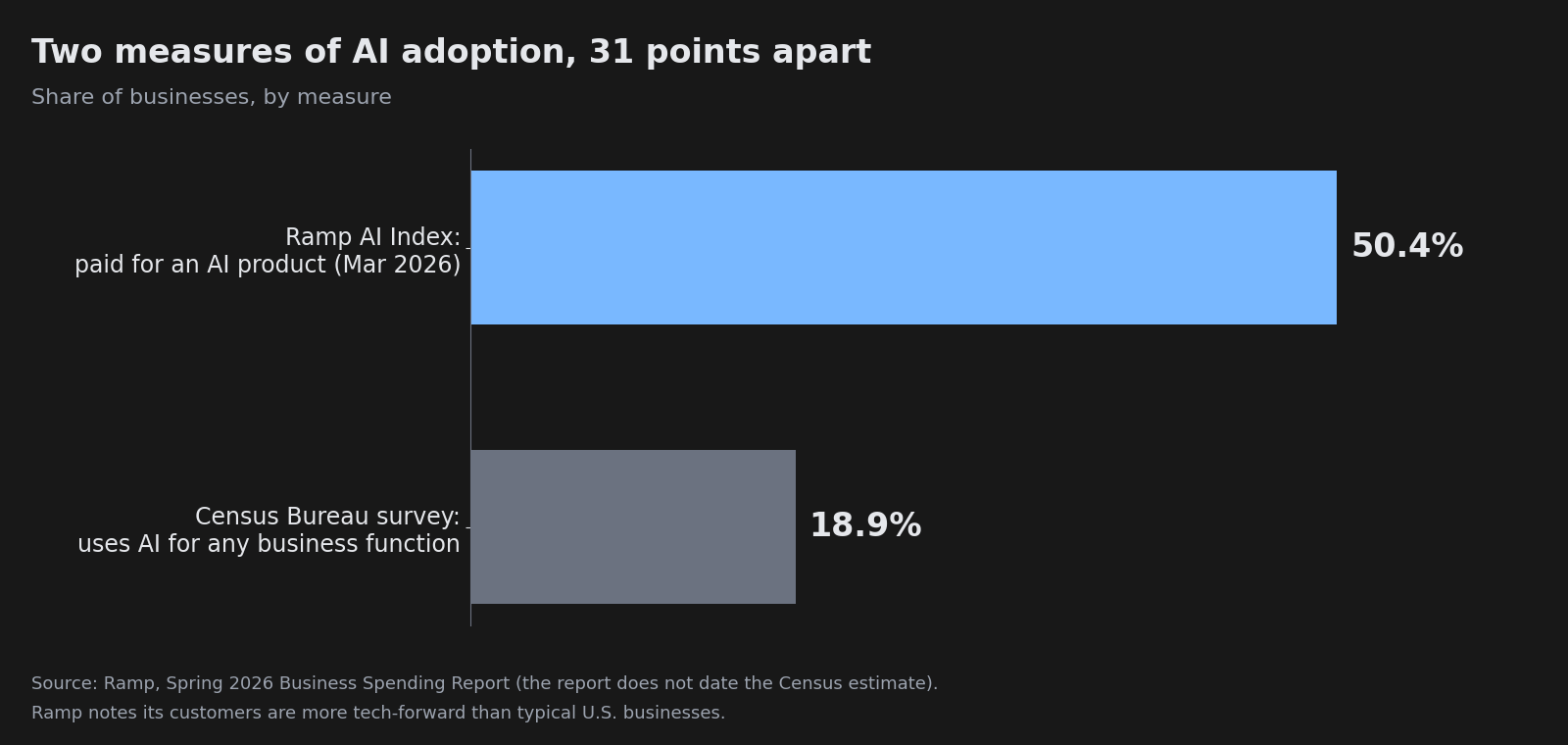
The chart uses March, the month the report pairs with the Census figure.
Paying for AI sounds like a stricter test than using it, yet Ramp’s number is higher. Part of the 31-point gap reflects who Ramp’s customers are, and part may reflect the question: a payment to a vendor Ramp classes as AI can register even when the firm would not tell a survey it uses AI for a business function. The lesson carries through this post: the sample and the question decide the answer. A payment tells me a business is trying AI. How much of its work runs on AI, and whether the spend pays back, need other measures.
Where a meter was running: an AI agent in customer service
The clearest return I have seen came from an AI customer service agent at a large consumer goods company. Before the build, we scoped which customer contacts across three service organizations the agent could resolve, at what cost and at what risk. The commercial structure put our fees at risk on the agent’s performance. Phase one went live in four months, the agent resolved about 30% of in-scope contacts without a human, and the savings were realized at about $7 million a year, tracked against value KPIs in recurring performance reviews with the client.
I should hold that number to the same standard I apply to everyone else’s, so here are its weaknesses:
- It is a before-and-after comparison. Anything else that changed contact volumes or costs in the period would show up in the number.
- My side had an incentive. With fees at risk, we had a reason to count generously.
Why I still believe it: the inputs are counts a contact center already keeps. Contacts, resolutions and cost per contact existed before the agent, were measured the same way after it, and were reviewed with the client every cycle. A meter that was running before the AI arrived is hard to bend afterwards. And these savings pass the test I apply to the survey numbers below: they were realized, and tracked in the same reviews.
Some of the best causal evidence on generative AI at work comes from the same kind of setting. Brynjolfsson, Li and Raymond studied the staggered rollout of an AI assistant to more than 5,000 customer support agents and found that issues resolved per hour rose about 14% on average, and 34% for novice and low-skilled agents, with minimal impact on experienced and highly skilled ones (NBER Working Paper 31161). That is a contact center again. It is where the meter was.
Where there was no meter: an internal AI platform
The second deployment was an internal AI platform at a large professional services firm: a retrieval tool that mapped a client’s finance processes to a standard taxonomy, and a generator for requirements documents and test cases. More than 250 consultants used them, and adoption among the target users passed 70%.
The value numbers looked even better. Pilot user surveys reported 80% less retrieval effort and 70% less drafting effort. As an economist, I would not put those numbers in a CFO’s budget, for three reasons:
- They are self-reported. Pilot users are often the people most likely to benefit and most willing to say so.
- A survey has no comparison group. Nobody in it did the same task without the tool.
- Time saved becomes money saved only if something else changes. Unless the hours turn into more output or fewer hires, the P&L does not move.
The tools may well work. The evidence for them stops at “users say it helps,” a weaker claim than “the business is better off.”
The evidence ladder, and the selection it creates
Put the two deployments side by side and a pattern appears. AI value claims sit on a ladder, and each rung is harder to reach than the one below it:
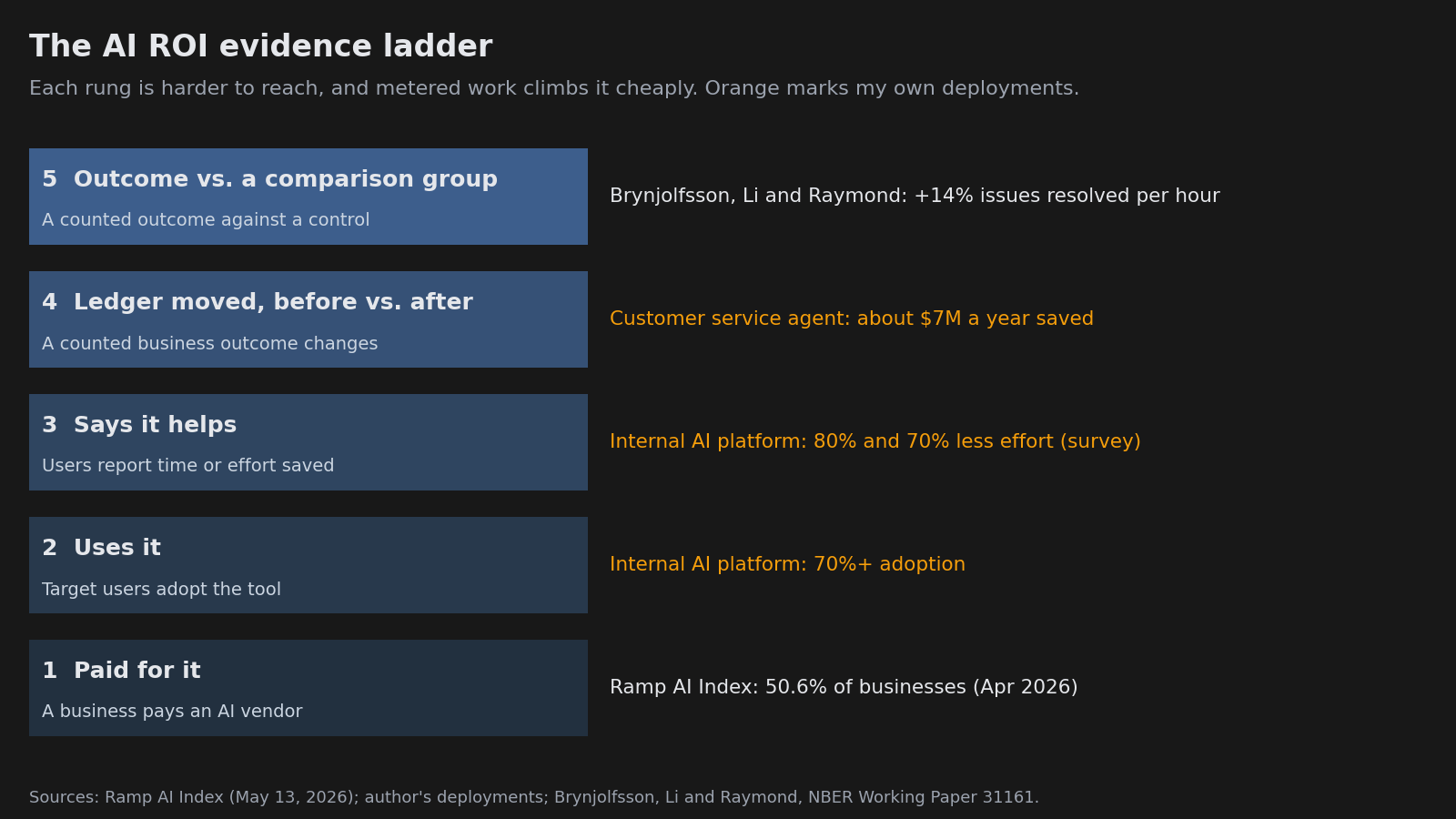
Metered work climbs the ladder cheaply, because the counts already exist. Knowledge work without a meter usually stalls at rung three, because building a comparison group costs time and money that a pilot rarely has. Ramp’s own data could fill the space between rungs one and three: a business that keeps paying month after month reveals that it values the tool, a stronger signal than a survey and a weaker one than a ledger.
That creates a selection problem in everything we read about AI returns. The proven cases over-represent metered work. So when a CFO sees strong ROI in customer service and soft, survey-based ROI in finance or strategy work, the gap may reflect returns, or it may reflect only where measurement is cheap. The published record cannot tell those apart, and I suspect it flatters metered work.
The obvious objection is that metered work may simply pay more: its tasks are well defined, and Brynjolfsson, Li and Raymond found the gains concentrated among novices. I take that seriously, and it is testable. If returns drive the gap, firms that build a meter in knowledge work will find small effects. If measurement drives it, the gap will narrow as meters spread.
How I would build the meter
For any AI tool in work without a natural meter, I would set up the measurement before the purchase order:
- Roll out in waves and compare teams that have the tool with teams that do not have it yet, before and after: a difference-in-differences design.
- Time a sample of real tasks with and without the tool. A stopwatch beats a survey.
- Follow the saved hours into something the business already counts, such as proposals shipped, engagements staffed or closes completed.
It is cheaper than it sounds. The customer service agent above already rolled out in phases across the U.S. and Mexico. Had we fixed the comparison in advance, it could have reached rung five.
Bottom line
AI pays back most visibly where the work is high-volume, well-defined and already metered. Elsewhere the gains may be just as real, but they stay self-reported until a firm builds the meter, and the firms that build it first will know where to spend.
FAQ
What share of businesses pay for AI? 50.6% of businesses on Ramp’s platform paid for an AI product in April 2026, according to the Ramp AI Index. Ramp notes its customers are more tech-forward than typical U.S. businesses; a Census Bureau survey that asks about any AI use gives a much lower figure.
Where does AI deliver measurable ROI? In high-volume, well-defined work that a business already counts, such as customer service contacts. The proven returns cluster there partly because that is where returns are easiest to prove.
How should a CFO measure AI ROI? Build the meter before buying the tool: roll out in waves, compare teams that have the tool with teams that do not yet, time a sample of real tasks, and follow saved hours into an output the business already tracks.