Impact of the One Big Beautiful Bill Act (P.L. 119-21) on the U.S. Healthcare System
A statutory, fiscal, and capital-markets decomposition of the $911B–$1.02T federal healthcare reconciliation package—and how coverage losses, work requirements, and the 2026 subsidy cliff transmit across payers, providers, PBMs, and retail pharmacies.
Scope & Conventions: Federal fiscal figures are nominal outlays over the 10-year budget window (FY2025–FY2034) from the Congressional Budget Office (CBO) cost estimate of the enacted reconciliation law (P.L. 119-21, signed July 4, 2025), as compiled by KFF (July/August 2025) and the Congressional Research Service (CRS R48633). Coverage figures represent CBO’s estimated change in the number of uninsured individuals in calendar year 2034 relative to the current-law baseline. Company financial, segment-mix, and membership metrics are sourced from FY2024 Forms 10-K, Q2 2025 Forms 10-Q/earnings releases, and investor conference calls through August 15, 2025. Analytical judgments and forward-looking market inferences are explicitly labeled.
1. Executive Summary
Core Thesis: The One Big Beautiful Bill Act (
P.L. 119-21) represents the largest federal healthcare retrenchment since the Affordable Care Act’s enactment, reducing federal health outlays by more than $1.0 trillion over FY2025–FY2034 and increasing the uninsured population by 10.0 million in 2034 (14.2 million when combined with the scheduled December 31, 2025 expiration of enhanced ACA premium tax credits). However, statutory timing, cross-market transmission, and capital-market pricing diverge sharply from headline narratives:
- 2026 is an ACA subsidy-cliff and morbidity shock; 2027–2032 is the OBBBA Medicaid and hospital-financing squeeze. Near-term 2026 marketplace disruption stems primarily from the scheduled non-OBBBA expiration of ARPA/IRA enhanced premium tax credits (
eAPTCs,+4.2Muninsured,+7.9%gross benchmark premiums) and special-enrollment/clawback tightening (§§71304–71305). OBBBA’s core Medicaid provisions—work requirements (§71119), six-month redeterminations (§71107), provider-tax phase-downs (§71115), and state-directed payment (SDP) caps (§71116)—are back-loaded between December 31, 2026 and FY2032.- Structural severance of the Medicaid-to-Marketplace safety net. Unlike the 2023–2024 post-PHE Medicaid unwinding—where disenrolled Medicaid members transitioned into subsidized ACA exchange plans—
§71119statutorily bars individuals disenrolled for work-requirement non-compliance from receiving ACA premium tax credits or cost-sharing reductions, turning Medicaid disenrollment into a one-way exit to uninsurance rather than an exchange volume tailwind.- Capital markets priced pre-OBBBA medical cost trend, not legislative headlines. Our 8-milestone event study (
N = 8public payers,T = 221estimation days, price data through August 14, 2025) demonstrates that once UnitedHealth’s May 2025 guidance suspension/DOJ probe and Centene’s July 1, 2025 Wakely risk-adjustment pre-announcement (−40.4%on July 2) are isolated, neither Senate passage (+1.0%CAR,p = 0.32), final House concurrence, nor Presidential signing produced a statistically significant abnormal return, and the High-minus-Low Medicaid exposure spread (CNC, ELV, MOHvs.HUM, CI) was indistinguishable from zero across every legislative vote (all p ≥ 0.32).
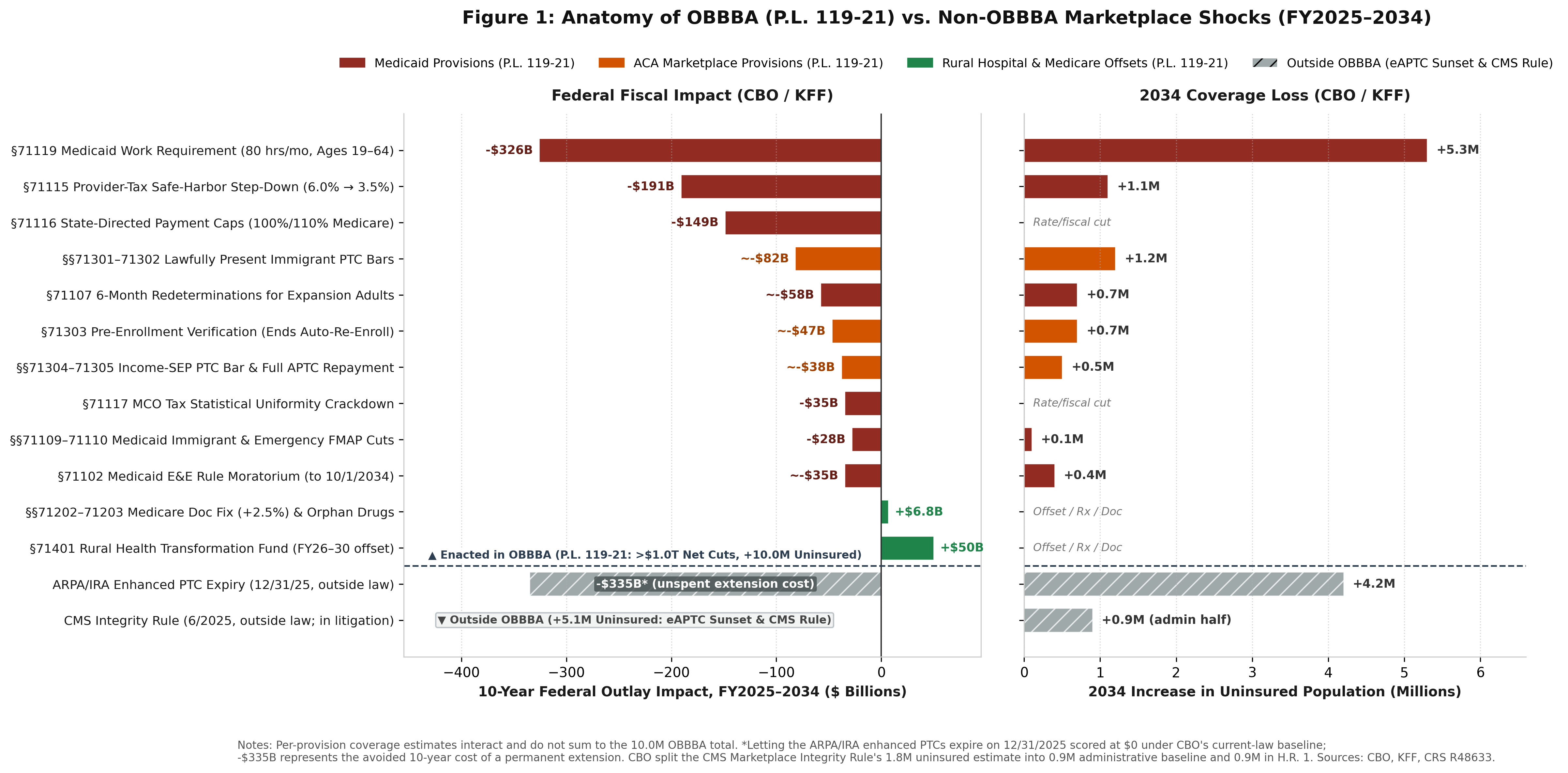
Click or tap the chart to open it at full resolution.
1.1 Seven Takeaways for Healthcare Strategy & Market Intelligence Leaders
- Scale and Concentration (
>$1.0TOutlay Reduction;+10.0MUninsured):P.L. 119-21reduces federal healthcare outlays by over $1.0 trillion (FY2025–FY2034) and increases the 2034 uninsured count by 10.0 million (KFF / CBO Summary). Three Medicaid provisions generate $666 billion (~65%) of the gross savings: mandatory community engagement/work requirements (§71119: −$326B, +5.3M uninsured), expansion-state provider-tax hold-harmless step-downs (§71115: −$191B, +1.1M uninsured), and state-directed payment rate caps (§71116: −$149B). - Dual-Front Contraction in the ACA Individual Market (
+2.4MGross Statutory vs.+4.2MeAPTC Sunset): Inside the statute,§§71301–71305restrict immigrant eligibility, eliminate PTC access via low-income Special Enrollment Periods (SEPs), remove excess-APTC repayment caps, and mandate pre-enrollment verification (ending passive auto-re-enrollment with APTC in 2028), adding 2.4 million uninsured across per-provision CBO scores. Outside the statute, the scheduled December 31, 2025 sunset of ARPA/IRA enhanced PTCs adds 4.2 million uninsured and raises gross benchmark Silver premiums by +7.9% (CBO), shrinking and worsening the morbidity of individual risk pools in 2026–2028. - Phased, Three-Wave Implementation Architecture (2026 vs. 2027 vs. 2028–2032): Because Senate Republicans held a 53–47 majority and passed the bill 51–50 via Vice President Vance’s tie-breaker, coalition arithmetic pushed the deepest fiscal pain past the 2026 midterms.
- Wave 1 (2026): Scheduled eAPTC expiration (
12/31/2025), full APTC repayment clawbacks (§71305), low-income SEP subsidy bar (§71304), sub-100% FPL immigrant PTC bar (§71302), and Bronze/Catastrophic HSA eligibility (§71307). - Wave 2 (2027): Mandatory Medicaid work requirements (
§71119) and 6-month redeterminations (§71107) effective December 31, 2026 (with good-faith state extensions up to December 31, 2028), plus 1-month retroactive Medicaid coverage limits (§71112) and Marketplace immigrant PTC bars (§71301). - Wave 3 (2028–2032): End of passive APTC auto-renewal (
§71303, PY2028), expansion-state provider-tax safe-harbor step-down from 6.0% to 3.5% (§71115, FY2028–FY2032), and existing SDP phase-downs of 10 percentage points per year (§71116, CY2028+).
- Wave 1 (2026): Scheduled eAPTC expiration (
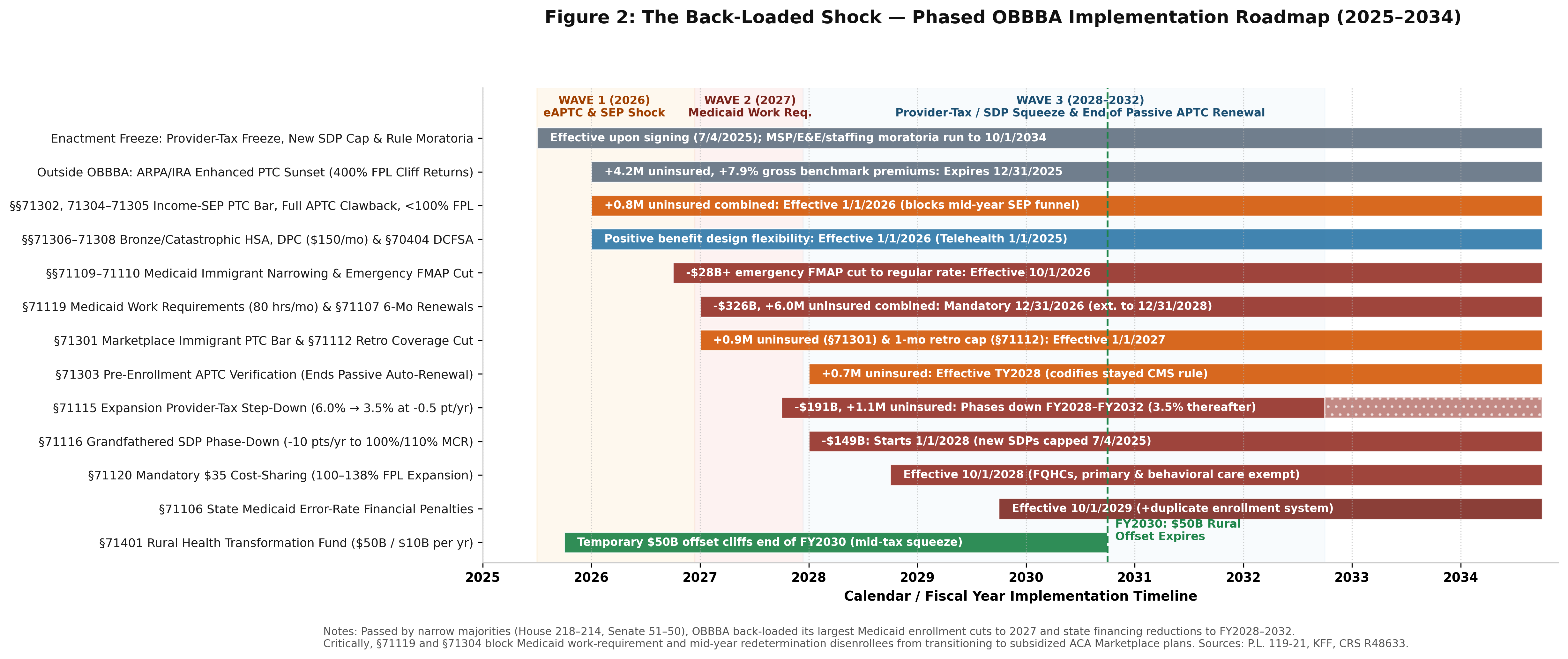
Click or tap the chart to open it at full resolution.
- Asymmetric Hospital Margin Squeeze and the FY2030 Rural Cliff: Expansion-state hospital systems lose $340 billion in combined federal provider-tax and SDP financing (
§§71115–71116) while absorbing higher uncompensated care from14.2 millionnewly uninsured residents. The Senate-added $50 billion Rural Health Transformation Program (§71401, $10B/year over FY2026–FY2030) and the rural exemption on new SDPs cushion rural facilities through 2030—but expire two full years before the provider-tax step-down reaches its 3.5% terminal floor in FY2032. - Cross-Vertical Transmission Across Payers, PBMs, and Retail Pharmacy: While
P.L. 119-21omitted direct PBM provisions due to Byrd Rule reconciliability constraints on commercial ERISA riders, diversified healthcare enterprises face distinct direct and second-order linkages across their underwriting, PBM, and retail/care-delivery engines:
| Enterprise Vertical | Direct OBBBA Statutory Exposure (P.L. 119-21) |
Indirect / Second-Order Strategic Transmission (2026–2032) |
|---|---|---|
| Health Care Benefits (Payers) | High in Medicaid & ACA; Neutral in MA/Commercial. Direct hit from §§71119, 71107 (Medicaid disenrollment & adverse selection) and §§71301–71305 (ACA verification & clawbacks). §71201 (Medicare immigrant limits) is de minimis; 4% Statutory PAYGO Medicare sequester is a year-end 2025 legislative waiver watch item. |
Carrier divergence & ICHRA shift: Pure-play government payers (CNC, MOH) face dual Medicaid/ACA compression. Carriers exiting the ACA exchanges before 2026 (CVS/Aetna, which announced on May 1, 2025 its complete 17-state exit covering ~1.0M lives) avoid 2026 eAPTC churn and exchange repricing risk. In commercial, §71307 (Bronze/Catastrophic HSA eligibility) accelerates Bronze + HSA ICHRA adoption among small/mid-size employers. |
| Health Services (PBMs & Specialty) | Zero PBM provisions enacted in P.L. 119-21. House Medicaid spread-pricing bans and Senate Part D delinking drafts were dropped. §71203 (ORPHAN Cures Act) broadens the IRA Medicare Drug Price Negotiation orphan-drug exclusion (+$4.9B CBO cost), delaying negotiation for multi-indication rare-disease drugs from 2028+. |
Script volume vs. specialty mix: Loss of 10.0M Medicaid/ACA lives (14.2M with eAPTC sunset) reduces lower-margin generic Medicaid/exchange script volumes over 2026–2030. Simultaneously, §71203 preserves high-list-price specialty brand economics in Part D, increasing reliance on PBM specialty formulary management and biosimilar substitution while bipartisan PBM reform shifts to year-end appropriations. |
| Pharmacy & Consumer Wellness / Care Delivery | Exemptions in §71120; Rural grants in §71401. Primary care, behavioral health, and FQHC visits are exempt from mandatory $35 Medicaid cost-sharing (§71120), and prescription drugs remain subject to nominal copays. |
Retail script elasticity & 340B compression: Uninsured consumers exhibit a 30%–45% drop in retail prescription fills and front-store foot traffic in low-income zip codes. Safety-net hospitals losing SDP/provider-tax funds face tighter operating margins, altering 340B contract-pharmacy dynamics and accelerating commercial hospital-rate cost-shifting onto employer plans. |
- Dropped Proposals Preserve Silver Loading and Leave ICHRA Regulation-Dependent: Three major House-passed or draft provisions fell out in the Senate: (a) CHOICE Arrangement (
ICHRA) statutory codification and the small-employer tax credit (House§§110201–110203), struck under the Byrd Rule; (b) Cost-Sharing Reduction (CSR) appropriations, dropped over Hyde Amendment abortion-funding disputes; and (c) expanded HSA contribution limits and Medicare Part A working-senior HSA eligibility. Consequently, Silver loading persists across ACA marketplaces, and ICHRA growth relies on the 2019 Tri-Agency rule reinforced by§71307Bronze-HSA pairing. - Empirical Event Study Verdict: Across 8 tradable legislative milestones from the February 25, 2025 House budget resolution (
H.Con.Res. 14) through the July 4, 2025 signing, de-confounded payer stock returns show no discrete pricing of Medicaid or provider-tax exposure on legislative vote days. Only Oscar Health (OSCR, 99% ACA individual market) exhibited a statistically significant negative event-day return (−2.31%/day,p = 0.013), concentrated around the May 2025 Energy & Commerce markup and House passage.
2. Fiscal Architecture and Reconciliation Constraints: Why the Law Took This Shape
2.1 The Fiscal Driver: Funding a $4.5 Trillion Tax Extension Through Medicaid
- The Tax Cut Mandate: Individual income and estate tax provisions of the 2017 Tax Cuts and Jobs Act (
TCJA,P.L. 115-97) were scheduled to expire on December 31, 2025. Extending and expanding them was the centerpiece of the 119th Congress’s reconciliation package. Under the concurrent budget resolution (H.Con.Res. 14, adopted by the House on February 25, 2025, amended by the Senate on April 5, and concurred in by the House on April 10), the House Ways and Means Committee received an allowance to increase the deficit by up to $4.5 trillion over FY2025–FY2034. - The $880 Billion Energy & Commerce Floor: To partially offset the tax package, Title II, Section 2001(b)(4) of
H.Con.Res. 14instructed the House Committee on Energy and Commerce (E&C) to report legislation reducing the deficit by at least $880 billion over FY2025–FY2034 (H. Rept. 119-106). Because Medicare benefits were politically off-limits by presidential directive, Medicaid was the only mandatory program within E&C’s jurisdiction large enough to generate ≥$880 billion in 10-year outlays. - Enacted Fiscal & Coverage Score (CBO):
- Net Deficit Impact: +$3.4 trillion over FY2025–FY2034 under CBO’s conventional current-law baseline (Senate Budget Committee / CBO Final Score, July 2025).
- Federal Healthcare Outlay Reductions: >$1.0 trillion over FY2025–FY2034, resulting in +10.0 million uninsured in 2034 (KFF / CBO Summary).
- Three Core Medicaid Savers ($666B Combined): Work requirements (
§71119: −$326B), provider-tax hold-harmless limits (§71115: −$191B), and state-directed payment caps (§71116: −$149B).
2.2 Reconciliation Mechanics: The Byrd Rule, Baseline Asymmetry, and Coalition Math
- The Byrd Rule (
2 U.S.C. §644) and Struck Provisions: Reconciliation bills pass the Senate with a simple majority (avoiding the 60-vote filibuster), but every provision must produce a non-incidental change in federal outlays or revenues. During the June 2025 Senate “Byrd bath,” the Senate Parliamentarian ruled several high-profile healthcare provisions out of order or forced material rewrites:- Struck as “merely incidental” non-budgetary policy: Codification of ICHRA / CHOICE Arrangements (
House §§110201–110203), permanent FMAP penalties on states using state-only funds to cover undocumented immigrants, federal bans on gender-affirming care in Medicaid/CHIP, and commercial PBM spread-pricing/delinking mandates. - Rewritten to survive Senate points of order: The Planned Parenthood funding ban (
§71113) was narrowed from a 10-year prohibition to a 1-year funding moratorium, and the SNAP/Medicaid state error-rate cost-sharing penalties (§71106) were restructured and delayed to FY2028–FY2030. - Dropped over Hyde Amendment / Byrd Rule cross-fire: Both House and Senate drafts included a direct federal appropriation for ACA Cost-Sharing Reductions (
CSRs) (which would have ended “Silver loading” and saved ~$30B by lowering benchmark Silver APTCs). It was dropped after the Parliamentarian advised that attaching new Hyde Amendment abortion restrictions to a newly created mandatory CSR appropriation violated the Byrd Rule, and Republican leadership refused to appropriate CSR funds without Hyde language.
- Struck as “merely incidental” non-budgetary policy: Codification of ICHRA / CHOICE Arrangements (
- Current-Policy vs. Current-Law Baseline Asymmetry:
- Under the current-policy baseline invoked by Senate Budget Chair Lindsey Graham (
§312of the Congressional Budget Act), extending existing TCJA tax rates was scored at nearly $0 (~$3.8Tof tax extensions treated as baseline continuation), allowing the bill to comply with Senate reconciliation instructions. - Conversely, the ARPA/IRA enhanced premium tax credits (
eAPTCs) were treated as temporary pandemic-era subsidies scheduled to expire on December 31, 2025. Under the current-law baseline, lettingeAPTCsexpire scored as $0 in savings, whereas extending them permanently would have added $335 billion in federal outlays over FY2025–FY2034 (CBO via KFF). This scoring asymmetry sealed the omission ofeAPTCsin reconciliation.
- Under the current-policy baseline invoked by Senate Budget Chair Lindsey Graham (
- Coalition Arithmetic and Delayed Phase-Ins: With razor-thin majorities (House 215–214 on May 22 and 218–214 on July 3; Senate 51–50 on July 1 with Sens. Collins, Murkowski, and Paul voting Nay), Senate leaders secured rural-state votes by delaying the provider-tax step-down (
§71115) and SDP phase-down (§71116) until 2028, allowing state work-requirement extensions through December 31, 2028, and inserting the $50 billion Rural Health Transformation Program (§71401).
3. Comprehensive Statutory Breakdown by Market Segment
Provisions are ordered within each segment by the magnitude of their 10-year federal fiscal and 2034 coverage impact (KFF; CRS R48633).
3.1 Medicaid and CHIP (Subtitle B, Part 1 — §§71101–71121)
§71119— Mandatory Community Engagement / Work Requirements (CBO: −$326B; +5.3M Uninsured):- Requires ACA Medicaid expansion adults (and §1115 waiver expansion equivalents) aged 19–64 to complete and verify ≥80 hours per month of work, community service, work program participation, or at least half-time educational enrollment.
- Statutory Exemptions: Pregnant and postpartum women, individuals medically frail or with complex disabling conditions, primary caregivers of dependent children aged 13 or younger (narrowed by the Senate from the House’s under-18 threshold), American Indians/Alaska Natives, and individuals already meeting TANF/SNAP work rules.
- Timeline & Non-Waivability: HHS must issue an interim final rule by June 1, 2026. States must implement by December 31, 2026 (or the first calendar quarter thereafter); the HHS Secretary may grant good-faith implementation extensions up to December 31, 2028. Section 1115 waivers cannot be used to waive this requirement. Provides $200M in FY2026 federal grants for state IT eligibility builds.
- The Marketplace Lockout Clause: Crucially, individuals denied or disenrolled from Medicaid for failing to meet or verify
§71119work requirements are statutorily barred from receiving ACA Marketplace premium tax credits (PTCs) or cost-sharing reductions (CSRs), severing the Medicaid-to-Marketplace coverage bridge (KFF Work Requirements Analysis).
§71115&§71117— Provider Tax Hold-Harmless Step-Down and MCO Tax Restrictions (CBO: −$191B and −$35B; +1.1M Uninsured):- Immediately freezes state provider taxes at rates and healthcare classes enacted or submitted as of July 4, 2025 (prohibiting new or increased provider taxes).
- For ACA expansion states, the federal “hold-harmless” safe-harbor threshold—long fixed at 6.0% of net patient revenue—steps down by 0.5 percentage points per year beginning in FY2028 (
10/1/2027:5.5%in FY28,5.0%in FY29,4.5%in FY30,4.0%in FY31), reaching a permanent cap of 3.5% in FY2032 (10/1/2031). Non-expansion states remain capped at 6.0% but are frozen at July 4, 2025 rates. - Exemptions & MCO Taxes: Nursing facilities and intermediate care facilities (
ICFs) are statutorily exempt from the 6.0% → 3.5% step-down. Separately,§71117(−$35B) tightens the statistical “broad-based and uniform” waiver test (effective upon enactment, with state transition grace periods through FY2028), curbing California- and Ohio-style tiered Managed Care Organization (MCO) taxes that taxed Medicaid revenue at far higher rates than commercial revenue.
§71116— State-Directed Payment (SDP) Rate Caps (CBO: −$149B):- Caps total Medicaid MCO state-directed payment rates for inpatient/outpatient hospital services, nursing facilities, and academic medical centers at 100% of Medicare payment rates in expansion states and 110% of Medicare rates in non-expansion states (down from CMS’s prior regulatory ceiling of the average commercial rate (
ACR), which frequently exceeded 200%–250% of Medicare). - Phase-Down Schedule: New SDPs enacted after July 4, 2025 are capped immediately (rural hospitals are exempt from the immediate cap on new SDPs). Grandfathered SDPs submitted or approved before July 4, 2025 phase down by 10 percentage points per year starting January 1, 2028 until reaching the 100%/110% Medicare ceiling.
- Caps total Medicaid MCO state-directed payment rates for inpatient/outpatient hospital services, nursing facilities, and academic medical centers at 100% of Medicare payment rates in expansion states and 110% of Medicare rates in non-expansion states (down from CMS’s prior regulatory ceiling of the average commercial rate (
§71107— Six-Month Eligibility Redeterminations for Expansion Adults (CBO: −$58B to −$63B; +0.7M Uninsured):- Requires states to conduct Medicaid eligibility renewals every 6 months (rather than every 12 months) for ACA expansion adults, effective for renewals scheduled on or after December 31, 2026, increasing procedural churn.
§71120— Mandatory Cost Sharing for Expansion Adults at 100%–138% FPL:- Effective October 1, 2028, requires expansion states to impose deductions/copayments (> $0 and up to $35 per service) on expansion adults with incomes between 100% and 138% FPL, subject to an aggregate household cap of 5% of family income. Primary care, mental health, substance use disorder (
SUD), and FQHC/RHC services are statutorily exempt, and prescription drugs remain governed by existing nominal Medicaid copay limits.
- Effective October 1, 2028, requires expansion states to impose deductions/copayments (> $0 and up to $35 per service) on expansion adults with incomes between 100% and 138% FPL, subject to an aggregate household cap of 5% of family income. Primary care, mental health, substance use disorder (
- Eligibility Verification, Retroactive Coverage, and Financing Moratoria:
§71101&§71102(Moratoria to 10/1/2034): Delays implementation of the Biden Administration’s Medicare Savings Program (MSP) and Medicaid/CHIP Streamlined Eligibility & Enrollment (E&E) rules until October 1, 2034 (+0.4Muninsured).§71103&§71104(Address, Duplicate-Enrollment, and Death-File Checks): Quarterly beneficiary address verification and quarterly Social Security Death Master File cross-checks effective January 1, 2027; federal interstate duplicate-enrollment clearinghouse effective October 1, 2029.§71106(MEQC Error-Rate Penalties): Effective October 1, 2029, reduces federal FMAP for erroneous Medicaid payments exceeding the statutory 3% Payment Error Rate Measurement (PERM) tolerance.§71109&§71110(Immigrant Eligibility & Emergency Medicaid FMAP): Effective October 1, 2026, restricts Medicaid/CHIP eligibility to LPRs, Cuban/Haitian entrants, and COFA citizens (+0.1Muninsured), and lowers the federal match for Emergency Medicaid provided to non-qualifying expansion-eligible immigrants from the 90% expansion FMAP down to the state’s regular FMAP (−$28Bfederal savings).§71111(LTC Staffing Moratorium): Blocks enforcement of CMS’s 2024 Minimum Staffing Standards for Long-Term Care Facilities rule until October 1, 2034 (−$23B).§71112(Retroactive Coverage Cut): Reduces retroactive Medicaid coverage from 90 days (3 months) to 1 month for expansion adults and 2 months for traditional enrollees, effective January 1, 2027 (−$14B).§71113(Reproductive Health Provider Moratorium): Prohibits federal Medicaid direct/MCO payments for 1 year to tax-exempt reproductive health entities receiving >$800K in FY2023 Medicaid funds that provide non-Hyde abortions (targeting Planned Parenthood; subject to immediate federal litigation).§71114(End of ARPA Expansion Incentive): Terminates the 5-percentage-point two-year FMAP bonus for newly expanding states if expansion occurs after January 1, 2026.§71118(Section 1115 Budget Neutrality): Codifies strict statutory budget-neutrality expenditure ceilings for §1115 demonstration waivers effective January 1, 2027.§71121(HCBS Waiver Flexibility): Creates a new state option starting July 1, 2028 to provide home- and community-based services (HCBS) without requiring institutional level-of-care certification.
3.2 ACA Individual Market (Subtitle B, Part 3 — §§71301–71305) & Concurrent Non-OBBBA Shocks
§71301— Immigrant Eligibility Narrowed for PTCs (CBO: −$68B; +0.9M Uninsured):- Effective for tax years beginning after December 31, 2026 (
TY2027), restricts Premium Tax Credit (PTC) eligibility to U.S. citizens/nationals, Lawful Permanent Residents (LPRs/green-card holders), Cuban/Haitian entrants, and Compact of Free Association (COFA) migrants. Excludes refugees, asylees, Temporary Protected Status (TPS) holders, DACA recipients, humanitarian parolees, and student/work visa holders, removing a younger, lower-utilization cohort from the risk pool.
- Effective for tax years beginning after December 31, 2026 (
§71302— Elimination of Sub-100% FPL Immigrant PTC Exception (CBO: −$14B to −$29B; +0.3M Uninsured):- Repeals IRC
§36B(c)(1)(B), which previously allowed lawfully present immigrants with incomes below 100% FPL who were barred from Medicaid by the 5-year waiting period to receive Marketplace PTCs. Effective January 1, 2026 (TY2026).
- Repeals IRC
§71303— Mandatory Pre-Enrollment Verification & End of Passive Auto-Renewal (CBO: −$41B to −$47B; +0.7M Uninsured):- Effective for plan years beginning after December 31, 2027 (
PY2028), exchanges cannot advance APTCs until the applicant affirmatively verifies household income, immigration status, residency, family size, and health-coverage status prior to enrollment. Effectively eliminates passive auto-re-enrollment with APTC and bars APTCs after a single year of failing to file and reconcile (FTR) prior-year tax credits.
- Effective for plan years beginning after December 31, 2027 (
§71304— Prohibition on PTC/CSR Eligibility via Income-Based SEPs (CBO: −$38B across§§71304–71305; +0.4M Uninsured):- Effective for plan years after December 31, 2025 (
PY2026), individuals enrolling through an income-based Special Enrollment Period (such as the ≤150% FPL monthly SEP) are barred from receiving PTCs or CSRs; subsidies remain available only for standard Qualifying Life Events (QLEs: loss of MEC, marriage, birth, permanent move) or Open Enrollment.
- Effective for plan years after December 31, 2025 (
§71305— Complete Removal of Excess APTC Repayment Caps (CBO: +0.1M Uninsured):- Effective for tax years after December 31, 2025 (
TY2026), repeals the sliding-scale statutory repayment caps ($375–$3,250) under IRC§36B(f)(2)(B). Enrollees whose actual year-end Modified Adjusted Gross Income (MAGI) exceeds their projected application income—including crossing the reinstated 400% FPL cliff by $1—must repay 100% of excess APTCs on Form 8962, deterring gig workers, hourly workers, and early retirees with volatile incomes.
- Effective for tax years after December 31, 2025 (
- Outside-OBBBA Shock #1: Scheduled Expiration of ARPA/IRA Enhanced PTCs (
12/31/2025Sunset; CBO: +4.2M Uninsured):- Enacted under the 2021 ARPA and extended through December 31, 2025 by the 2022 Inflation Reduction Act (
P.L. 117-169), the enhanced PTCs were omitted fromP.L. 119-21and are scheduled to expire on December 31, 2025 unless Congress acts in late-2025 appropriations. - Two-Part Impact: (1) Reinstates the hard 400% FPL subsidy cliff (
~$62,600single /~$128,600family of four for 2026), eliminating subsidies above 400% FPL; and (2) raises required household premium contributions across 100%–400% FPL from0%–8.5%of income back to~2.1%–9.96%(turning $0-premium Silver plans for ≤150% FPL enrollees into ~$35–$70/month premium obligations and raising average net premiums for subsidized enrollees by >75%). CBO estimates the sunset increases the 2034 uninsured population by +4.2 million and drives a +7.9% increase in gross benchmark Silver premiums via adverse selection (KFF).
- Enacted under the 2021 ARPA and extended through December 31, 2025 by the 2022 Inflation Reduction Act (
- Outside-OBBBA Shock #2: CMS 2025 Marketplace Integrity & Affordability Final Rule (
90 Fed. Reg. 27074, June 25, 2025; CBO: +1.8M Uninsured,0.9MNet OutsideH.R. 1):- Shortened Open Enrollment (
Nov 1–Dec 15), eliminated the ≤150% FPL monthly SEP, excluded DACA recipients, tightened income-discrepancy verification, and imposed a$5/monthpremium penalty on passive$0-premium auto-re-enrollees. CBO scored the standalone rule as increasing the uninsured by +1.8 million (roughly0.9Moverlapping with§§71303–71304and0.9Mfrom administrative friction). - Litigation Status (City of Columbus v. Kennedy): Municipalities and health advocacy groups filed suit on July 1, 2025 in the U.S. District Court for the District of Maryland (
Civ. No. 25-cv-02114) seeking a preliminary injunction to stay the$5passive auto-re-enrollment penalty, the mid-year failure-to-reconcile termination rule, the mandatory pre-enrollment SEP verification rule, and the widenedde minimisactuarial value bands (−4/+2pts) prior to Open Enrollment. However, OBBBA§§71303–71305independently wrote the SEP subsidy bar, full APTC clawback, and 2028 pre-enrollment verification directly into federal statute, insulating those pillars from Administrative Procedure Act (APA) challenges.
- Shortened Open Enrollment (
3.3 Hospitals, Rural Providers, Physicians, and Long-Term Care
- Expansion-State Acute & Behavioral Hospitals: Bear the combined −$340 billion federal reduction from
§71115provider-tax limits and§71116SDP rate caps (2028–2032), compounded by rising bad debt and charity care from14.2 millionnewly uninsured individuals. §71401— Rural Health Transformation Program (+$50.0Bover FY2026–FY2030):- Appropriates $10.0 billion per year (
FY2026–FY2030) for CMS grants to states to stabilize rural hospitals, support service-line restructuring, expand telehealth/technology, and fund rural clinician recruitment. Half ($25B) is distributed equally across all qualifying states with approved rural transformation plans, and half ($25B) is allocated at the CMS Administrator’s discretion based on rural population, facility distress, and low-income burden. Rural hospitals are also exempt from the immediate§71116cap on new SDPs.
- Appropriates $10.0 billion per year (
§71202— Medicare Physician Fee Schedule (MPFS) Temporary Patch (+$1.9B):- Provides a one-year +2.5% statutory increase to the Medicare Physician Fee Schedule conversion factor for services furnished between January 1, 2026 and December 31, 2026 (
CY2026), partially offsetting the-2.83%CY2025 cut. Expires January 1, 2027, setting up a year-end 2026 “doc fix” cliff.
- Provides a one-year +2.5% statutory increase to the Medicare Physician Fee Schedule conversion factor for services furnished between January 1, 2026 and December 31, 2026 (
- Nursing Facilities & Long-Term Care (
§71111,§71115): Emerging as clear institutional winners, skilled nursing facilities (SNFs) and ICFs secure both a 9-year moratorium on the CMS minimum staffing rule (§71111, through10/1/2034) and a complete statutory exemption from the6.0% → 3.5%provider-tax hold-harmless step-down (§71115).
3.4 Medicare, Medicare Advantage, and Part D (Subtitle B, Part 2 — §§71201–71203)
§71201— Medicare Immigrant Eligibility Narrowed (CBO: −$5.1B; +0.1M Uninsured):- Aligns Medicare Part A and Part B non-citizen eligibility with the narrowed
§71301categories (LPRs, Cuban/Haitian entrants,COFAmigrants), even for lawfully present non-citizens with 40 quarters of payroll-tax work history. Effective upon enactment for new applicants; current non-qualifying beneficiaries are disenrolled 18 months after enactment (January 4, 2027).
- Aligns Medicare Part A and Part B non-citizen eligibility with the narrowed
§71203— Broadened Orphan-Drug Exclusion from IRA Medicare Drug Price Negotiation (ORPHAN Cures Act; CBO: +$4.9B):- Amends Social Security Act
§1192(e)(3)(A)to exempt drugs designated for one or more rare diseases or conditions from the Inflation Reduction Act’s Medicare Drug Price Negotiation Program (previously limited to drugs designated for only one rare disease), and clarifies that the 7-year (small molecule) / 11-year (biologic) negotiation clock starts only upon the first non-orphan FDA approval. Applies beginning with the Initial Price Applicability Year (IPAY) 2028 selection cycle (February 2026), preserving brand pricing power on blockbuster multi-indication oncology and immunology assets (e.g., Darzalex, Keytruda, Opdivofollow-on orphan expansions) and modestly raising gross Part D / MA-PD specialty drug spend.
- Amends Social Security Act
- No Direct MA Rate, Risk-Adjustment (
V28), or Star Rating Provisions — and the Statutory PAYGO Sequester Watch:P.L. 119-21contained no direct cuts to Medicare Advantage benchmarks, coding intensity adjustments, or Star bonuses (which benefited from CMS’s April 7, 2025 Final CY2026 Rate Announcement of+5.06%).- Because
P.L. 119-21added$3.4Tto the 10-year deficit without an internal Statutory Pay-As-You-Go (PAYGO,2 U.S.C. §934) scorecard wipe, CBO reported in May/July 2025 that OMB would be required at the end of the congressional session to issue a sequestration order reducing mandatory spending—including a maximum 4% Medicare payment sequester (~$45Bin FY2026) under2 U.S.C. §935—unless Congress waives the PAYGO scorecard balances in a year-end 2025 continuing resolution or appropriations package (as Congress has done after every major deficit-increasing statute since 2010, including the 2017 TCJA and 2021 ARPA).
3.5 Employer-Sponsored Coverage, HSAs, HDHPs, DPC, and ICHRA (§§71306–71308, §70404)
§71306— Permanent Telehealth HDHP Safe Harbor (CBO: +$4.5B):- Permanently allows High-Deductible Health Plans (
HDHPs) to cover telehealth and remote-care services on a first-dollar basis prior to the deductible without disqualifying enrollees from contributing to a Health Savings Account (HSA), retroactive to plan years beginning after December 31, 2024.
- Permanently allows High-Deductible Health Plans (
§71307— Bronze and Catastrophic Individual Plans Treated as HSA-Qualified HDHPs (CBO: +$3.6B):- Effective January 1, 2026, amends IRC
§223(c)(2)so that any Bronze-level or Catastrophic plan available in the individual market (both on-Exchange and off-Exchange, per IRC§223(c)(2)(H)referencing ACA§1302(d)(1)(A)and(e)) automatically qualifies as an HSA-compatible HDHP, even if its out-of-pocket maximum ($10,600single /$21,200family in 2026) exceeds the standard IRS HDHP OOP limit ($8,500/$17,000) or covers pre-deductible copay visits.
- Effective January 1, 2026, amends IRC
§71308— Direct Primary Care (DPC) HSA Compatibility (CBO: +$1.8B):- Effective January 1, 2026, allows HSA holders to enroll in Direct Primary Care (
DPC) retainer arrangements without losing HSA eligibility and permits tax-free HSA distributions to pay DPC membership fees up to $150/month for an individual ($300/month for a family), indexed annually for inflation.
- Effective January 1, 2026, allows HSA holders to enroll in Direct Primary Care (
- Workforce & Family Tax Benefits (
§70404,§70401,§70402):§70404(Dependent Care FSA): Permanently raises the tax-free Dependent Care FSA exclusion limit from$5,000(unchanged since 1986) to $7,500 ($3,750married filing separately) effectiveTY2026(McDermott Will & Schulte, July 2025).§70401(IRC§45FEmployer Childcare Credit): Increases the credit rate from 25% to 40% (50% for eligible small businesses) and raises the maximum annual credit from$150Kto $500,000 ($600,000 for small businesses), indexed fromTY2026(CRS IF12379).§70402(IRC§45SPaid Family & Medical Leave Credit): Makes the employer tax credit permanent and allows employers to claim it for paid-leave insurance policy premiums (PwC Benefits Alert, July 2025).
- ICHRA / CHOICE Arrangements & QSEHRA Implications:
- Because the Senate stripped House
§§110201–110203(statutory codification of ICHRAs as “CHOICE Arrangements,” the$100/monthsmall-employer tax credit, and Section 125 cafeteria-plan salary reduction for on-Exchange plans) under the Byrd Rule (Marsh McLennan Agency / HRA Council, July 2025), ICHRA remains governed by the June 2019 Tri-Agency final rule. - Net ICHRA Impact: While higher gross individual-market premiums (
+7.9%from the eAPTC sunset) and§71303verification friction create headwinds,§71307is a structural catalyst for ICHRA administrators (Take Command, Thatch, Remodel Health, Venteur) and individual-market carriers (Oscar, Ambetter), enabling employers to fund an ICHRA allowance toward a lower-premium Bronze plan paired with a tax-advantaged HSA.
- Because the Senate stripped House
3.6 Pharmacy Benefit Managers (PBMs)
- Zero PBM Provisions in
P.L. 119-21: House and Senate proposals to ban Medicaid MCO spread pricing, mandate NADAC + professional dispensing fee reimbursement, require 100% commercial ERISA rebate pass-through, and delink Medicare Part D PBM compensation from list prices were excluded from the final reconciliation text after the Senate Parliamentarian struck commercial ERISA provisions under the Byrd Rule. - Strategic Outlook: The omission removes an immediate statutory overhang from the three national PBMs (
CVS Caremark, Express Scripts/Evernorth, Optum Rx), which have already begun transitioning commercial clients toward transparent pass-through and cost-plus models (e.g., CVS TrueCostandCostVantage). Standalone bipartisan PBM legislation remains a primary watch item for late-2025 year-end healthcare appropriations packages, while OBBBA’s10.0Mcoverage reduction (and4.2MeAPTC sunset) creates a modest multi-year headwind to aggregate Medicaid and exchange script volumes.
4. Legislative Evolution: Proposed vs. Enacted Matrix
| Policy Area | House Passed (5/22/2025) |
Senate Passed (7/1/2025) & Enacted Law (P.L. 119-21, 7/4/2025) |
Strategic Consequence |
|---|---|---|---|
Medicaid Work Requirements (§71119) |
Initial E&C draft: Jan 1, 2029 start; floor manager’s amendment pulled forward to 12/31/2026; exempted parents of children <18 |
Enacted at 12/31/2026 (good-faith state extensions to 12/31/2028); tightened parental exemption to children ≤13; barred disenrollees from ACA PTCs |
Largest coverage cut (−$326B, +5.3M uninsured); severs Medicaid-to-ACA transition funnel |
Provider Tax Limits (§71115, §71117) |
Freeze existing provider tax rates at enactment (6.0% safe harbor preserved) |
Freeze PLUS expansion-state hold-harmless step-down from 6.0% to 3.5% (−0.5 pt/yr, FY2028–FY2032); SNFs & ICFs exempt; MCO uniformity tightened |
Deepens long-term hospital/state fiscal squeeze (−$191B + −$35B), but delays impact until FY2028 |
State-Directed Payments (§71116) |
Cap new SDPs at 100%/110% of Medicare; grandfathered existing SDPs indefinitely |
Eliminated permanent grandfathering: existing SDPs phase down −10 pts/yr from Jan 1, 2028 to 100% (expansion) / 110% (non-expansion) of Medicare; new rural SDPs exempt |
Major blow to safety-net and for-profit hospitals (−$149B; UHS, THC, CHS) |
Rural Hospital Offset (§71401) |
Not in House bill | Added $50B Rural Health Transformation Program ($10B/yr, FY2026–FY2030) to secure rural GOP Senate votes |
Cushions rural hospitals through 2030, creating a post-2030 fiscal cliff |
ACA Cost-Sharing Reduction (CSR) Funding |
Appropriated CSRs (ends Silver loading) |
Dropped in Senate after Hyde Amendment abortion-language & Byrd Rule clash | Silver loading continues; preserves wide Bronze/Gold discount mechanics |
ICHRA / CHOICE Codification (§§110201–03) |
Codified ICHRA as CHOICE Arrangements + $100/mo small-employer tax credit + Sec. 125 exchange pay |
Dropped in Senate (Byrd Rule point of order) | ICHRA remains anchored on 2019 rule; aided indirectly by §71307 Bronze-HSA |
HSA / HDHP Expansion (§§71306–71308) |
10-provision package (doubled HSA contribution limits, Part A seniors, gym/fitness fees, spouse catch-up) | Scaled back to 3 provisions: permanent telehealth safe harbor (§71306), Bronze/Catastrophic = HDHP (§71307), DPC compatibility (§71308) |
§71307 unlocks HSA pairing for all ACA Bronze plans (+$9.9B combined cost) |
Enhanced ACA PTCs (ARPA/IRA) |
Omitted (allowed to expire) | Omitted — scheduled to expire 12/31/2025 (+$335B 10-yr cost avoided under current-law baseline) |
Primary driver of projected 2026 ACA net-premium spike and +4.2M uninsured |
| PBM Reform | Medicaid spread-pricing ban & NADAC transparency | Dropped from OBBBA under Byrd Rule constraints | Immediate statutory relief for Caremark, Express Scripts, Optum Rx; shifts to year-end 2025 watch |
5. Chronological Implementation & Policy Timeline (2016–2034)
- December 2016: 21st Century Cures Act creates Qualified Small Employer HRAs (
QSEHRAs). - December 2017: Tax Cuts and Jobs Act (
P.L. 115-97) zeroes out the ACA individual mandate penalty (effective 2019) and schedules individual tax cuts to sunset on December 31, 2025. - June 2019: Tri-Agency final rule establishes Individual Coverage HRAs (
ICHRAs, effective January 1, 2020). - March 2021 & August 2022: American Rescue Plan Act (
ARPA) introduces enhanced PTCs (removing the 400% FPL cliff and providing $0 benchmark Silver plans for ≤150% FPL); Inflation Reduction Act (IRA) extends them through December 31, 2025. - February 25 – April 10, 2025: House adopts budget resolution
H.Con.Res. 14(217–215, Feb 25); Senate adopts amended version (51–48, April 5 at 2:26 AM EDT); House concurs (216–214, April 10), locking in the≥$880BEnergy & Commerce savings instruction. - May 1, 2025: CVS Health announces that Aetna will completely exit the ACA individual exchanges across all 17 states for plan year 2026 (
~1.0Mmembers). - May 11–14, 2025: House E&C releases Medicaid reconciliation text (May 11 evening) and concludes 26-hour markup (
30–24, May 14 at ~4:15 PM EDT). - May 20, 2025: CBO releases preliminary distributional and coverage estimate for the House reconciliation bill.
- May 22, 2025 (6:54 AM EDT): House passes
H.R. 1(215–214, with 1 Present). - June 25, 2025: CMS publishes the final Marketplace Integrity and Affordability Rule (
90 Fed. Reg. 27074). - July 1, 2025 (12:05 PM EDT): Senate passes amended
H.R. 1(51–50, VP Vance breaking the tie). That evening after market close, Centene withdraws its 2025 guidance on Wakely ACA risk-adjustment data. - July 3, 2025 (2:31 PM EDT): House concurs in the Senate amendment (
218–214), 91 minutes after the NYSE’s 1:00 PM EDT early pre-Independence Day close. - July 4, 2025: President signs
P.L. 119-21into law. Provider-tax freeze (§71115), cap on new non-rural SDPs (§71116), MSP/E&E/LTC staffing moratoria (§§71101, 71102, 71111), and new-applicant Medicare immigrant limits (§71201) take effect immediately. Telehealth HDHP safe harbor (§71306) applies retroactively to January 1, 2025. - July–August 2025: Federal preliminary-injunction litigation proceeds in City of Columbus v. Kennedy (
D. Md., filed July 1, 2025) challenging key provisions of the CMS Marketplace Integrity Rule; KFF and CRS (R48633) publish comprehensive CBO per-provision cross-walks ofP.L. 119-21. - December 31, 2025: Scheduled expiration of ARPA/IRA enhanced PTCs (+4.2M uninsured; +7.9% gross benchmark premiums).
- January 1, 2026 (Wave 1 Takes Effect):
- ACA low-income SEP subsidy bar (
§71304), full excess-APTC clawback (§71305), and sub-100% FPL immigrant PTC bar (§71302). - Bronze/Catastrophic HSA eligibility (
§71307), DPC HSA compatibility (§71308),$7,500Dependent Care FSA (§70404), and expanded§45F/§45Semployer credits. - One-year
+2.5%Medicare Physician Fee Schedule patch (§71202), end of ARPA 5-pt expansion FMAP bonus (§71114), and launch of the$50BRural Health Transformation Program (§71401, FY2026–FY2030).
- ACA low-income SEP subsidy bar (
- June 1, 2026: Statutory deadline for HHS interim final rule on
§71119Medicaid work requirements. - October 1, 2026: Medicaid immigrant eligibility restrictions (
§71109) and Emergency Medicaid FMAP reduction (§71110) take effect. - December 31, 2026 / January 1, 2027 (Wave 2 Takes Effect):
- Mandatory Medicaid work requirements (
§71119) and 6-month redeterminations (§71107) begin (with good-faith extensions up to12/31/2028). - Marketplace immigrant PTC restrictions (
§71301), 1-month Medicaid retroactive coverage limit (§71112), quarterly address/death-file checks (§§71103–71104), §1115 waiver budget neutrality (§71118), and 18-month disenrollment of non-qualifying Medicare immigrants (§71201).
- Mandatory Medicaid work requirements (
- 2028 (Wave 3 Begins):
- January 1, 2028: Mandatory ACA pre-enrollment verification ends passive APTC auto-renewal (
§71303); existing hospital SDPs begin-10 pt/yrphase-down (§71116); broadened orphan-drug negotiation exclusions apply to IPAY 2028 (§71203). - FY2028 (
10/1/2027): Expansion-state provider-tax safe harbor steps down from6.0%to5.5%(§71115). - July 1, 2028: New Medicaid HCBS waiver option (
§71121). - October 1, 2028: Mandatory
$35Medicaid cost-sharing for expansion adults at 100%–138% FPL (§71120). - December 31, 2028: Hard statutory deadline for all state Medicaid work-requirement extensions (
§71119).
- January 1, 2028: Mandatory ACA pre-enrollment verification ends passive APTC auto-renewal (
- October 1, 2029: Federal interstate duplicate-enrollment system (
§71103) and state MEQC error-rate FMAP penalties (§71106). - September 30, 2030: $50B Rural Health Transformation Program (
§71401) expires. - FY2032 (
10/1/2031): Expansion-state provider-tax hold-harmless threshold reaches its 3.5% terminal floor (§71115). - October 1, 2034: Statutory moratoria on MSP (
§71101), E&E (§71102), and nursing-home staffing (§71111) rules expire.
6. Cross-Market & Competitive Impact Analysis
6a. Coverage Losses by Population Cohort
| Population Cohort | Statutory / Policy Mechanism | CBO 2034 Uninsured Effect | Effective Date |
|—|—|—|—|
| Medicaid Expansion Adults (Aged 19–64) | Mandatory work requirements (§71119); 6-month redeterminations (§71107) | +5.3M (§71119); +0.7M (§71107) | 12/31/2026 (ext. to 12/31/2028) |
| Medicaid Enrollees Broadly | Provider-tax phase-down state responses (§71115); E&E rule moratorium (§71102) | +1.1M (§71115); +0.4M (§71102) | FY2028; 7/4/2025 |
| Lawfully Present Immigrants | Medicaid (§71109), ACA PTC (§71301), <100% FPL bar (§71302), Medicare (§71201) | +0.1M; +0.9M; +0.3M; +0.1M | 2025–2027 |
| Low-Income ACA Marketplace Enrollees | Income-SEP bar (§71304); pre-enrollment verification (§71303); full clawback (§71305) | +0.4M; +0.7M; +0.1M | PY2026; PY2028; TY2026 |
| Enacted Law Net Total (P.L. 119-21) | Interactive CBO score across all Title VII health provisions | +10.0M | Phased 2025–2034 |
| ACA Marketplace Enrollees (Outside Law) | Scheduled expiration of ARPA/IRA enhanced PTCs (12/31/2025 sunset) | +4.2M | 1/1/2026 |
| ACA Marketplace Enrollees (CMS Rule) | CMS 2025 Marketplace Integrity Rule (0.9M net outside H.R. 1 overlap) | +1.8M (+0.9M net) | PY2026 (in litigation) |
Note: Per-provision CBO coverage estimates interact and therefore do not sum linearly to the +10.0M enacted total. Critically, §71119 prevents the +5.3M Medicaid work-requirement disenrollees from qualifying for subsidized ACA Marketplace coverage, concentrating uninsurance among low-income expansion-state adults.
6b. Segment-Level Direction and Risk-Pool Mechanics
| Market Segment | Net Direction | Primary Statutory & Market Drivers |
|—|—|—|
| Medicaid Managed Care | Negative (Volume & Acuity) | §§71119, 71107 remove healthier working/churning expansion adults; §§71115–71116 compress state capitation & SDP pass-through revenue from 2028+ |
| ACA Individual (Subsidized Silver/Gold) | Negative (Volume & Morbidity) | Scheduled 12/31/2025 eAPTC sunset + §§71301–71305 verification & clawback friction drive adverse selection and +7.9% gross benchmark premium pressure |
| ACA Individual (Bronze / Catastrophic + HSA) | Positive (Relative Share) | §71307 makes all on- and off-Exchange Bronze/Catastrophic plans HSA-eligible, creating a lower-premium refuge for subsidy-cliff and ICHRA buyers |
| Commercial Employer Group | Neutral Direct / Negative Indirect | Direct benefits from §§71306, 71308, 70404; indirect upward pressure on commercial hospital unit prices (+1.5%–3.0%) as systems offset −$340B in Medicaid cuts |
| Medicare Advantage & Part D | Neutral (Direct) | §§71201–71203 have modest direct impact; §71203 orphan-drug exemption raises Part D specialty spend from 2028+; 4% Statutory PAYGO sequester expected to be waived |
| HSA Custodians, DPC, & Telehealth | Positive | §§71306–71308 permanently expand the HSA-addressable market (HealthEquity, Fidelity, Optum Bank, One Medical, Hint Health) |
| ICHRA / CHOICE Administrators | Mixed (Structurally Positive Mix) | Dropped statutory codification, but §71307 Bronze-HSA pairing improves small-group affordability math relative to small-group renewal trend |
6c. Providers, Care Delivery, and State Fiscal Dynamics
- Hospital Systems in Expansion States vs. Non-Expansion States: Because
§71115steps down the provider-tax safe harbor (6.0% → 3.5%) only in expansion states and§71116caps SDPs at100%of Medicare in expansion states vs.110%in non-expansion states (while§71119work requirements apply only to expansion adults), hospital revenue compression is overwhelmingly concentrated in the 40 Medicaid expansion states + DC. - State Trigger Laws (
90%FMAP Preserved, Provider-Tax Funding Hit): Twelve expansion states (Arizona, Arkansas, Illinois, Indiana, Iowa, Montana, New Hampshire, North Carolina, Utah, Virginia, Washington, and Idaho) have statutory “trigger laws” that automatically terminate or require legislative re-authorization of Medicaid expansion if the federal expansion FMAP drops below90%. BecauseP.L. 119-21left the90%statutory expansion FMAP intact (§71114only repealed the temporary 5-pt ARPA bonus for new states), automatic FMAP triggers are not tripped on enactment. However, North Carolina (Session Law 2023-7) and Utah explicitly tie expansion continuation to the availability of hospital provider assessments to fund the non-federal 10% share—creating a legislative flashpoint in FY2028–FY2032 as§71115ratchets the provider-tax threshold down to 3.5%. - State Administrative & Budgetary Pressure: States must deploy work-requirement verification and 6-month redetermination engines by December 31, 2026 (
$200Mfederal IT grant in§71119), absorb lower Emergency Medicaid matching rates from October 1, 2026 (§71110,−$28B), and manage MEQC error-rate FMAP penalties starting October 1, 2029 (§71106).
6e. Competitive Landscape & Company-Level Exposure Analysis (Through August 2025)
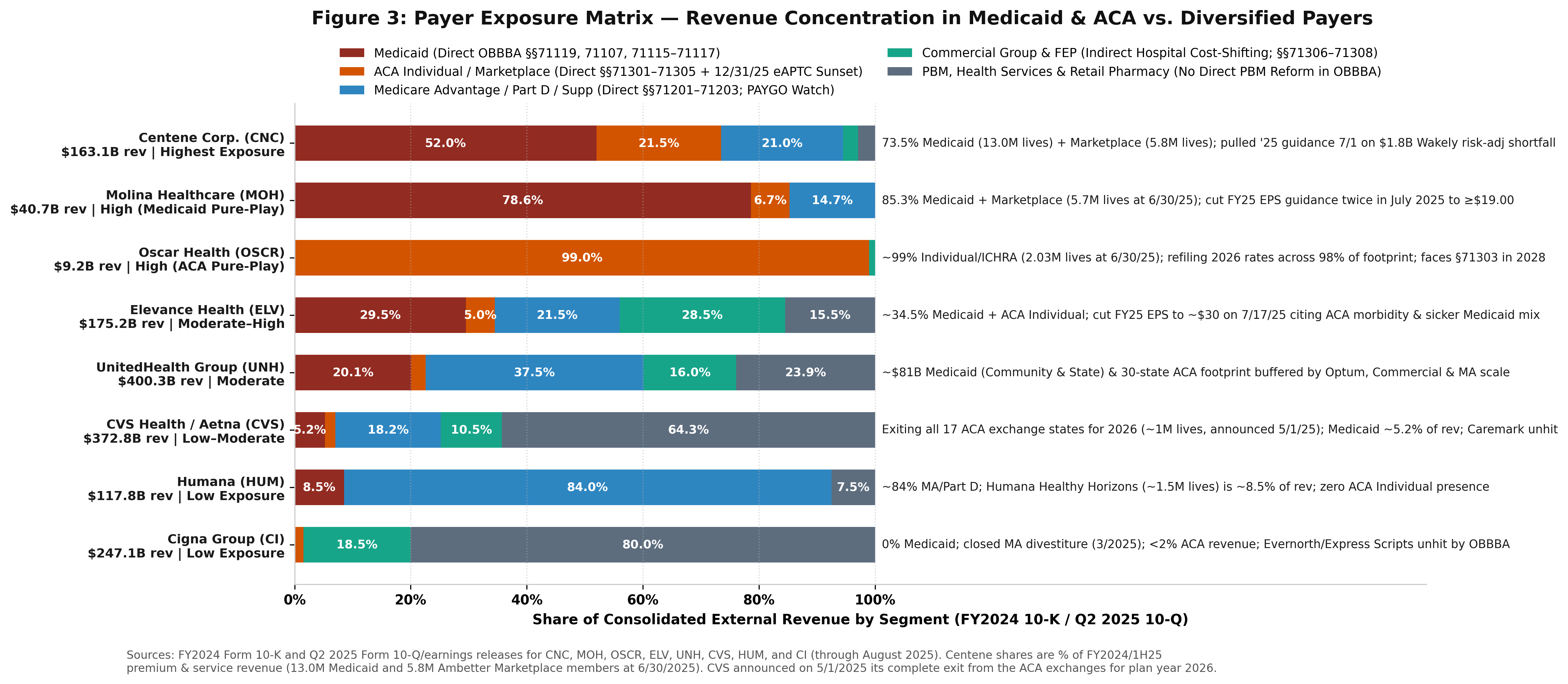
Click or tap the chart to open it at full resolution.
Empirical Context: The July 2025 Guidance Resets and Wakely Morbidity Shock
- July 1–2, 2025 Sector Selloff: After market close on July 1, 2025 (the same day the Senate passed
H.R. 1), Centene withdrew its 2025 guidance after independent actuarial firm Wakely delivered 2025 ACA Marketplace risk-adjustment data across 22 of Centene’s 29 states (72%of its Marketplace membership), revealing lower market-wide enrollment growth and significantly higher market morbidity than priced, cutting Centene’s expected 2025 net risk-adjustment revenue transfer by $1.8 billion (~$2.75/share) (Centene Release, July 1, 2025). On July 2, Centene fell −40.37% (~$11Bmarket cap loss), dragging down Molina (−21.9%), Oscar (−18.7%), Elevance (−11.5%), and UnitedHealth/Humana (−3% to −5%) (Reuters, July 2, 2025). - Attribution (Judgment): The July 2025 guidance resets across Centene, Molina, Elevance, and Oscar were driven by in-year 2025 ACA Marketplace morbidity (
Wakelyrisk scores) and Medicaid rate-actuarial lag, not byP.L. 119-21provisions (which take effect from 2026–2028 onward). However,P.L. 119-21and the scheduled December 31, 2025 expiration of enhanced PTCs compound 2026–2028 pricing uncertainty, prompting carriers to refile 2026 ACA rates across almost their entire footprints during July–August 2025.
Publicly Traded Payers (Ranked by OBBBA Exposure)
1. Centene Corporation (CNC) — Highest Exposure (~74% Medicaid + ACA Revenue)
- Segment Revenue Mix (FY2024 10-K & Q2 2025 10-Q): FY2024 total revenue of $163.1 billion (
$145.5Bpremium and service revenue), comprising Medicaid ~52%–57%, Commercial Marketplace (Ambetter) ~21%–24% across 29 states, Medicare Advantage & PDP ~15%–21%, and Other/TRICARE ~3%–4%. As of June 30, 2025 (Q2 2025 release, July 25, 2025), Centene served 13.0 million Medicaid members (with ACA expansion adults representing ~18% of its Medicaid book) and 5.8 million Marketplace (Ambetter) members (up from4.4Min Q2 2024). - Q2 2025 Results & 2026 Repricing Actions:
- Following its July 1 guidance withdrawal (
stock −40.37%on July 2), Centene reported a Q2 2025 adjusted diluted loss of −$0.16/share on July 25, 2025 (Q2 HBR 93.0%vs.87.6%in Q2 2024) and re-established FY2025 adjusted EPS guidance of ~$1.75 (down from prior>$7.25). - Management announced it is actively refiling 2026 Ambetter rates across all 29 Marketplace states to embed higher baseline morbidity, programmatic verification tightening (
§§71304–71305), and the scheduled12/31/2025eAPTC expiration, prioritizing margin recovery over enrollment volume for 2026.
- Following its July 1 guidance withdrawal (
- Strategic Assessment: Most exposed payer across all three OBBBA channels:
§§71119/71107(Medicaid expansion disenrollment starting 2027),§71116(SDP pass-through compression in 2028+), and§§71303–71305(Marketplace verification and clawbacks).
2. Molina Healthcare (MOH) — High Exposure (~85% Medicaid + ACA Revenue)
- Segment Revenue Mix (FY2024 10-K & Q2 2025 10-Q): FY2024 total revenue of $40.7 billion (
$38.6Bpremium revenue), comprising Medicaid ~79% ($30.5B), Medicare (D-SNP / MMP) ~14% ($5.5B), and ACA Marketplace ~7% ($2.6B, growing to ~10% in 1H 2025 across 14 states). Total membership stood at 5.7 million at June 30, 2025 (~5.0MMedicaid,~620KMarketplace). - July 2025 Double Guidance Cut:
- Molina lowered its FY2025 adjusted EPS guidance twice in July 2025: first on July 8, 2025 (
from $24.50 to $21.50–$22.50) and again on July 23, 2025 (to ≥$19.00), citing elevated medical cost pressure in Medicaid (Q2 2025 MCR 91.3%) and disproportionate morbidity pressure in its ACA Marketplace book (Molina Q2 2025 Release, July 23, 2025; Reuters, July 23, 2025; Bloomberg, July 24, 2025).
- Molina lowered its FY2025 adjusted EPS guidance twice in July 2025: first on July 8, 2025 (
- Strategic Assessment: Highest pure-play Medicaid concentration among publicly traded peers, exposing Molina directly to
§§71119, 71107, 71115–71116, and 71120from 2027 onward, while management is repositioning 2026 Marketplace pricing defensively.
3. Oscar Health (OSCR) — High ACA Exposure (~99% Individual Market & ICHRA)
- Segment Revenue Mix (FY2024 10-K & Q2 2025 10-Q): FY2024 revenue of $9.2 billion, ~99% concentrated in the ACA Individual Market and small-group ICHRA across 18–20 states. Effectuated membership reached 2.027 million as of June 30, 2025 (up from
1.58Mat June 30, 2024). - July 2025 Guidance Revision & 2026 Rate Refilings:
- On July 22, 2025, Oscar pre-announced a Q2 2025 operating loss of ~$230 million (
Q2 MLR 91.1%) and revised FY2025 guidance to an operating loss of $200M–$300M (from prior operating profit guidance of$225M–$275M) after Wakely data showed elevated market risk scores. Oscar announced it is refiling 2026 rates in states covering ~98% of its membership (Yahoo Finance / Investing.com, July 22, 2025). - CEO Mark Bertolini emphasized on the call: “We are taking appropriate pricing actions for 2026 that reflect higher acuity in the individual market.”
- On July 22, 2025, Oscar pre-announced a Q2 2025 operating loss of ~$230 million (
- Strategic Assessment: Zero Medicaid exposure, positioned to capture displaced share from Aetna’s 2026 exchange exit and to leverage
§71307Bronze + HSA ICHRA pairings, but directly exposed to 2026 eAPTC/SEP attrition (§§71304–71305) and the 2028 termination of passive APTC auto-re-enrollment (§71303).
4. Elevance Health (ELV) — Moderate–High Exposure (~35% Medicaid + ACA Revenue)
- Segment Revenue Mix (FY2024 10-K & Q2 2025 10-Q): FY2024 operating revenue of $175.2 billion, with Health Benefits divided into Commercial & Individual ~33% (
ACA Individual ~5%of consolidated revenue), Medicaid ~30%, Medicare ~21%, and Carelon (PBM & Services) ~16%. - Q2 2025 Guidance Cut & Management Commentary:
- On July 17, 2025, Elevance reported Q2 2025 medical membership of 45.6 million (down
212KQoQ on Medicaid redetermination tails and ACA attrition) and cut FY2025 adjusted EPS guidance to ~$30.00 (from$34.15–$34.85), citing “elevated medical cost trends in ACA and slower rate alignment in Medicaid” (Elevance Q2 2025 Release, July 17, 2025). - Elevance shares fell −10.9% on July 17. Executives warned that utilization and rate-alignment headwinds would persist into 2026 “mostly as a result of” the reconciliation package and eAPTC sunset (Healthcare Dive, July 17, 2025), and noted that
§71119work requirements will likely shift state Medicaid risk pools “toward a sicker patient profile” (Reuters, July 17, 2025).
- On July 17, 2025, Elevance reported Q2 2025 medical membership of 45.6 million (down
5. UnitedHealth Group (UNH) — Moderate Exposure (~22% Medicaid + ACA Revenue)
- Segment Revenue Mix (FY2024 10-K & Q2 2025 10-Q): FY2024 consolidated revenue of $400.3 billion, with UnitedHealthcare representing
~75%of external revenue: Medicare & Retirement (M&R) ~37%, Employer & Individual (E&I) ~18%–20% (ACA Individual ~2%–3%across 30 states), Community & State (Medicaid) ~20% ($80.6B, 7.6M members at Q2 2025), and Optum (Optum Health, Optum Insight, Optum Rx) ~24% external. - Q2 2025 Guidance Reinstatement: Following its May 13, 2025 guidance suspension and CEO transition to Stephen Hemsley, UNH reinstated full-year 2025 adjusted EPS guidance of ≥$16.00 on July 29, 2025, noting disciplined 2026 ACA rate refilings across its 30-state footprint and multi-year state engagement ahead of the 2027 Medicaid work-requirement rollout (
§71119). Optum Rx faces no direct PBM statutory mandates underP.L. 119-21.
6. CVS Health / Aetna (CVS) — Low–Moderate Exposure (~5.2% Medicaid Revenue; Exiting ACA for 2026)
- Segment Revenue Mix (FY2024 10-K & Q2 2025 10-Q): FY2024 consolidated revenue of $372.8 billion across three integrated segments:
- Health Care Benefits (
Aetna— ~35% of consolidated revenue /$130.7B): Commercial (~10.5%), Medicare Advantage & PDP (~18.2%), Medicaid (Aetna Better Health— ~5.2% of consolidated revenue /~$19.5B, ~2.0M members), and ACA Individual (~1.8%in 2025, dropping to 0% in 2026). - Health Services (
CVS Caremark& Care Delivery — ~42%): PBM, specialty pharmacy, Oak Street Health, and Signify Health. - Pharmacy & Consumer Wellness (~23%): >9,000 retail and community pharmacies.
- Health Care Benefits (
- Strategic Insulation via Pre-OBBBA Exchange Exit: On May 1, 2025 (in its Q1 2025 earnings announcement), CVS announced a complete exit from the ACA individual exchanges for plan year 2026 across all 17 states (
~1.0 millionmembers) after projecting$750M–$1.0Bin 2025 exchange underwriting losses (AJMC, May 2025). That decisive exit insulates CVS/Aetna from the 2026 eAPTC expiration shock, Wakely risk-adjustment contagion, and§§71301–71305exchange turbulence—contributing to CVS’s +25.3% de-confounded cumulative abnormal return during the February–July 2025 legislative window (and its July 31, 2025 FY2025 adjusted EPS guidance raise to$6.30–$6.40). Direct OBBBA exposure is confined toAetna Better HealthMedicaid (§71119in 2027) and modest retail pharmacy script elasticity.
7. The Cigna Group (CI) — Low Exposure (~1.5% ACA Individual; 0% Medicaid)
- Segment Revenue Mix (FY2024 10-K & Q2 2025 10-Q): FY2024 consolidated revenue of $247.1 billion, dominated by Evernorth Health Services (
Express Scripts / Accredo— ~80%) and Cigna Healthcare (~20%, primarily commercial ASO/insured). Having closed the divestiture of its Medicare Advantage business to HCSC on March 19, 2025, Cigna has zero Medicaid presence,<2%of revenue in ACA Individual plans across 11 states (~500Klives), and no PBM provisions enacted against Evernorth.
8. Humana Inc. (HUM) — Low Exposure (~8.5% Medicaid; 0% ACA Individual)
- Segment Revenue Mix (FY2024 10-K & Q2 2025 10-Q): FY2024 consolidated revenue of $117.8 billion, with Medicare Advantage & PDP accounting for ~84%, Medicaid (
Humana Healthy Horizons) ~8.5% (~1.5Mlives across 11–13 states), and CenterWell / Military ~7.5%. Zero ACA individual-market presence. Exposed primarily to§71203Part D specialty drug costs from 2028+, modest Medicaid expansion redeterminations, and year-end Statutory PAYGO waiver dynamics.
Investor-Owned Hospital Systems & Government Services Vendors (Q2 2025 Disclosures, July–August 2025)
| Organization | Disclosed OBBBA / ACA Financial Impact (July–August 2025 Calls) | Key Geographic & Operational Drivers | Effective Window |
|—|—|—|—|
| Universal Health Services (UHS) | $360M–$400M annual reduction by 2032 (“worst-case scenario” on $1.2B expected 2025 Medicaid supplemental net benefit; ~60% in behavioral health) + $50M–$100M/yr eAPTC expiry drag (6%–6.5% of acute admissions) | High expansion-state behavioral & acute footprint; CEO Marc Miller called OBBBA the “worst-case scenario” (Healthcare Dive, Aug 2025; Becker’s, Aug 2025; Fierce Healthcare) | 2026 (eAPTC); 2028–2032 (§§71115–71116) |
| Community Health Systems (CHS) | $300M–$350M cumulative EBITDA reduction over 13 years from provider-tax/SDP caps (excluding volume loss), partly offset by $40M–$60M/yr lower cash taxes from §163(j) EBITDA interest-deduction restoration | Rural hospital portfolio qualifies for §71401 RHTP funds through FY2030; CFO Kevin Hammons pledged to pursue administrative/legislative fixes (Healthcare Dive, Aug 2025) | Immaterial 2025–2027; builds 2028+ |
| Tenet Healthcare (THC) | Declined to quantify multi-year 2028–2032 impact on Q2 2025 call; guided $1.1B–$1.2B in expected 2025 Medicaid supplemental payments (Healthcare Dive, Aug 2025) | High-margin USPI ambulatory surgery centers (~50% of EBITDA) have <5% Medicaid mix, insulating consolidated cash flow | 2028–2032 |
| HCA Healthcare (HCA) | Characterized by CEO Sam Hazen on the July 25, 2025 Q2 call as “manageable” over the next several years | ~60% of Medicaid volumes and revenue reside in non-expansion states (Texas, Florida), which are exempt from the 6.0% → 3.5% tax step-down and retain a 110% Medicare SDP cap (Q2 2025 Call) | 2028+ |
| Ardent Health (ARDT) | $150M–$175M worst-case EBITDA impact by 2035; de minimis in 2026–2027 | New Mexico and Oklahoma SDP programs expected to be grandfathered through 2028 (ASC News, Aug 2025) | 2028–2035 |
| Maximus (MMS) & Eligibility Vendors | Direct Beneficiary: On the August 7, 2025 Fiscal Q3 2025 call, CEO Bruce Caswell projected §71119 work requirements and §71107 6-month renewals to lift U.S. Services growth into the mid-to-high single-digit range over time, starting in FY2027 | Statute precludes Medicaid MCOs from adjudicating community-engagement compliance on behalf of states (HHS rules due 6/1/2026), driving state outsourcing to Maximus, Gainwell, Conduent, Deloitte, Equifax/The Work Number (FQ3 2025 Transcript, Aug 7, 2025) | FY2027+ |
7. Synthesis of Structural Winners and Losers
Structural Winners
- Eligibility, Verification, and Income-Data Vendors (
Maximus, Equifax/The Work Number, Gainwell, Deloitte, Conduent): Mandatory 6-month Medicaid redeterminations (§71107), 80-hour work verification (§71119, with MCOs barred from adjudicating eligibility), and 2028 pre-enrollment Marketplace verification (§71303) create a multi-billion-dollar state and federal IT/BPO contracting cycle starting in FY2026–FY2027. - HSA Custodians, Direct Primary Care (
DPC) Networks, and Telehealth Platforms (§§71306–71308): Permanent first-dollar telehealth HDHP coverage, universal HSA eligibility for all on- and off-Exchange Bronze and Catastrophic plans, and tax-free HSA reimbursement for DPC retainers ($150/$300per month) expand the consumer-directed health ecosystem. - Skilled Nursing Facilities (
SNFs) & Intermediate Care Facilities (ICFs) (§71111,§71115): Secured both a 9-year moratorium on CMS minimum staffing mandates (−$23B) and a statutory carve-out from the expansion-state provider-tax phase-down. - Rare-Disease Biopharma Manufacturers (
§71203): The ORPHAN Cures Act shields multi-indication orphan drugs from IRA Medicare Drug Price Negotiation beginning with IPAY 2028 (+$4.9B). - Pharmacy Benefit Managers (
PBMs— Near-Term Statutory Reprieve): Commercial and Part D PBM reform provisions were stripped fromP.L. 119-21. - Diversified / Non-Exchange Payers (
CVS/Aetna, Cigna, Humana): Insulated from 2026–2028 ACA exchange turbulence (with CVS exiting all 17 ACA exchanges ahead of 2026) and minimal or manageable Medicaid exposure.
Structural Losers
- Medicaid Expansion Adults & Low-Income ACA Enrollees (
§§71119, 71107, 71301–71305+ eAPTC Sunset): Account for the vast majority of the10.0Mstatutory and4.2MeAPTC coverage losses, compounded by the§71119bar on transitioning from work-requirement disenrollment to subsidized ACA coverage. - Lawfully Present Non-LPR Immigrants (
§§71109, 71301, 71302, 71201): Refugees, asylees, and TPS holders lose access to Medicaid, ACA PTCs, and Medicare (+1.4Mcombined uninsured across provisions). - Safety-Net and Expansion-State Hospital Systems (
UHS, CHS, THC, Non-Profit Academic & Safety-Net Systems): Lose $340 billion in federal provider-tax and SDP funding over 2028–2032 (§§71115–71116) while absorbing uncompensated-care spikes. - Government-Concentrated Payers (
Centene, Molina, Oscar, Elevance): Face sequential waves of ACA eAPTC/SEP contraction (2026), Medicaid work-requirement attrition and adverse selection (2027), and passive auto-renewal / SDP headwinds (2028+).
8. Strategic Monitoring Calendar (Late 2025 – 2030)
| Milestone / Catalyst | Target Date | Strategic Significance for Market Intelligence |
|---|---|---|
| Year-End 2025 Congressional Session: Enhanced PTCs, Statutory PAYGO Waiver, & PBM Riders | Q4 2025 |
Determines whether the 12/31/2025 eAPTC sunset (+4.2M uninsured) takes effect on schedule, whether Congress waives the 4% Statutory PAYGO Medicare sequester, and whether standalone PBM reform attaches to year-end appropriations |
| CMS Marketplace Integrity Rule Litigation (City of Columbus v. Kennedy) | August 2025 – 2026 |
Pending federal preliminary injunction decision (D. Md.) on 2026 rule provisions ahead of §71303 statutory verification in 2028 |
| 2026 ACA Open Enrollment & Effectuated Enrollment Readout | Nov 1, 2025 – Q1/Q2 2026 |
First empirical test of 2026 rate refilings (CNC, OSCR, MOH), Aetna’s 17-state exit (~1M lives), and §§71304–71305 SEP/clawback friction |
HHS Interim Final Rule on Medicaid Work Requirements (§71119) |
Statutory deadline 6/1/2026 |
Governs state IT verification rules and good-faith state extension approvals (12/31/2026 vs. 12/31/2028) |
| Wave 2 Go-Live: Medicaid Work Requirements, 6-Month Renewals & Retroactive Cut | 12/31/2026 – 1/1/2027 |
Largest single coverage shock (+6.0M combined uninsured across §§71119, 71107); watch ex parte verification rates and hospital bad-debt ratios |
Wave 3 Go-Live: End of Passive APTC Auto-Renewal (§71303) & SDP/Provider-Tax Step-Downs |
10/1/2027 (FY28 tax) & 1/1/2028 (PY28 ACA / SDP) |
Critical retention test for ACA pure-plays (OSCR) and start of the 5-year -0.5 pt/yr provider-tax and -10 pt/yr SDP hospital margin squeeze |
Expiration of $50B Rural Health Transformation Program (§71401) |
9/30/2030 (FY2030 end) |
$10B/yr rural hospital grant cushion expires two years before the 3.5% provider-tax floor hits in FY2032 |
Appendix A. Capital Market Event Study: Did Investors Price OBBBA on Legislative Headline Days?
Executive Summary of Empirical Findings: Across the five core legislative milestones (
May 14 – July 7, 2025) and the extended eight-milestone reconciliation timeline (February 26 – July 7, 2025), headline negative abnormal returns for publicly traded payers are overwhelmingly explained by two firm-specific earnings shocks rather than legislative votes: (1) UnitedHealth’s May 13–15, 2025 guidance withdrawal, CEO resignation, and WSJ DOJ investigation report (UNH −32.6%CAR), and (2) Centene’s July 1, 2025 after-hours withdrawal of 2025 guidance on Wakely ACA risk-adjustment data (CNC −40.4%on July 2, triggering sector contagion). Once those two firm-specific confounders are removed:
- Senate passage (
7/1/2025) flips from−16.0%(p < 0.001) to+1.0%(Patell p = 0.32), and final enactment (7/3–7/7/2025) is flat (−0.5%,p = 0.86).- High-Medicaid payers (
CNC, ELV, MOH) did not underperform Low-Medicaid peers (HUM, CI) on any legislative milestone (all p ≥ 0.32). Even at House passage (5/22/2025,−8.3%portfolio CAR), Medicare Advantage pure-play Humana fell−11.1%, demonstrating that the May selloff reflected macro bond-yield and MA regulatory fear rather than OBBBA Medicaid pricing.- Oscar Health (
OSCR) is the sole exception, exhibiting a statistically significant negative abnormal return on de-confounded legislative event days (−2.31%/day,HC1 p = 0.013), driven by its 99% revenue concentration in the ACA individual market (§§71301–71305).
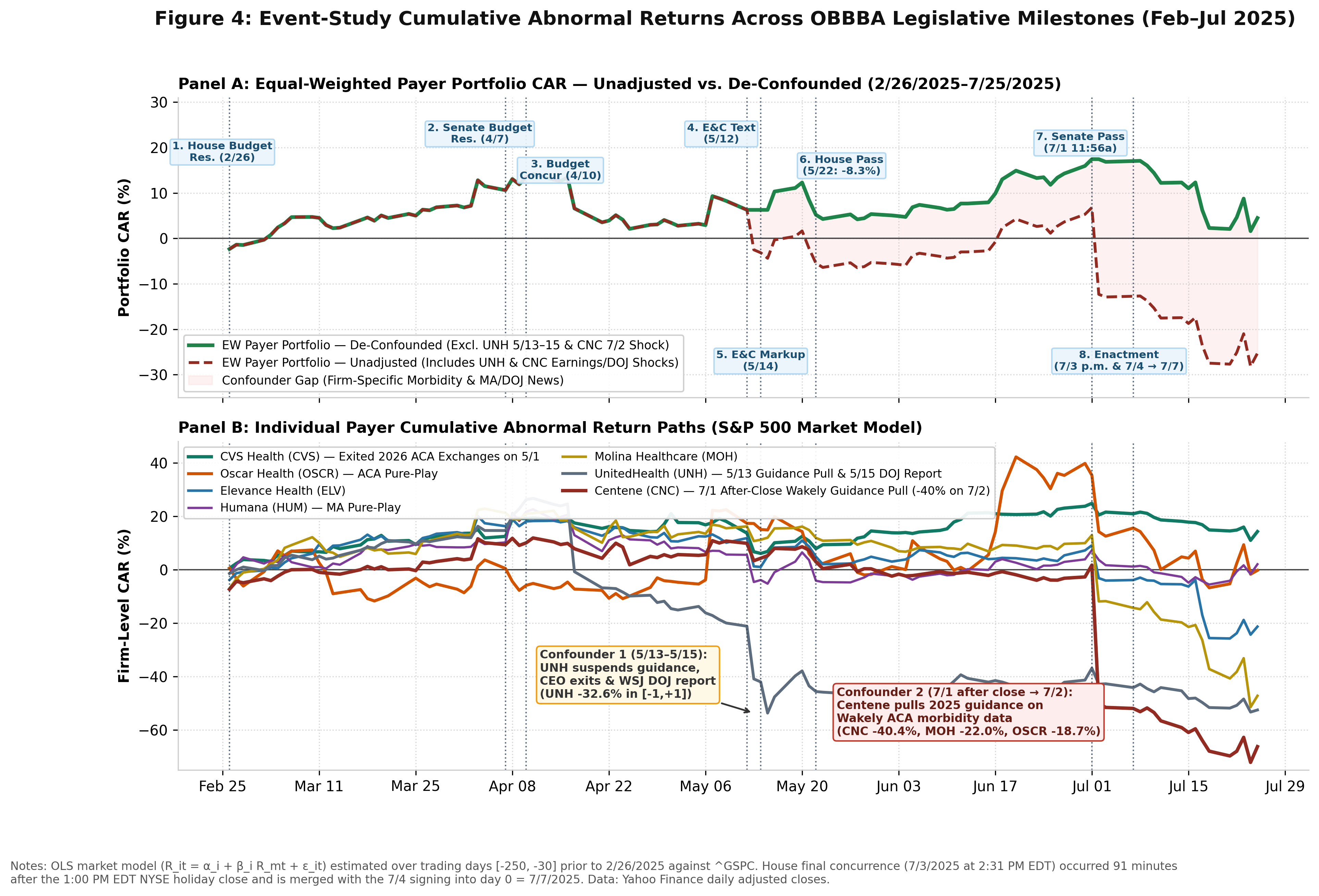
Click or tap the chart to open it at full resolution.
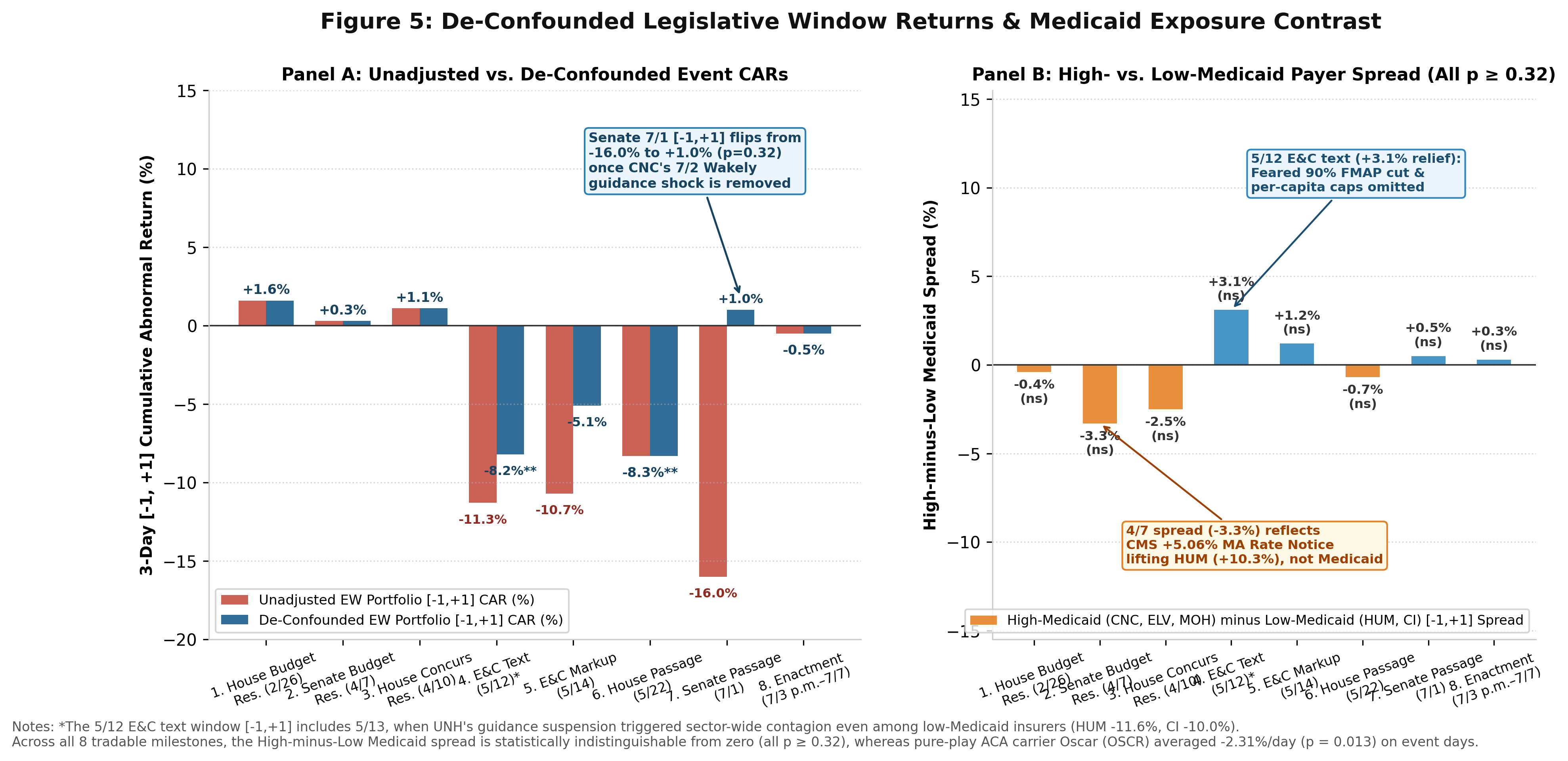
Click or tap the chart to open it at full resolution.
A.1 Baseline Five-Event Study (May 14 – July 7, 2025)
A.1.1 Data, Market Model, and Test Statistics
- Sample & Price Data: Daily adjusted closing prices (
auto_adjust=True) from Yahoo Finance covering2024-01-02to2025-08-14for five primary payers (UNH, ELV, CVS, CNC, OSCR), three supplementary peers (MOH, HUM, CI), the S&P 500 index (^GSPC), and the Health Care Select Sector SPDR ETF (XLV). Daily log returns \(R_{it} = \ln(P_{it}/P_{i,t-1})\) are used throughout (0missing values). - Market Model & Estimation Window: For each stock \(i\), we estimate \(R_{it} = \alpha_i + \beta_i R_{mt} + \varepsilon_{it}\) via ordinary least squares (
OLS) over trading days[-250, -30]prior to the first event (2024-05-14to2025-04-01, \(T = 221\) trading days). Ending the estimation window on April 1, 2025 cleanly excludes the April 2–9, 2025 tariff volatility shock and the April 7, 2025 CMS Medicare Advantage Rate Notice.- Estimated
^GSPCParameters (\(T = 221\)):UNH(\(\beta = 0.26, \hat{\sigma} = 1.84\%\)),ELV(\(\beta = 0.21, \hat{\sigma} = 1.69\%\)),CVS(\(\beta = 0.39, \hat{\sigma} = 2.35\%\)),CNC(\(\beta = 0.15, \hat{\sigma} = 2.07\%\)),OSCR(\(\beta = 1.21, \hat{\sigma} = 4.29\%\)),MOH(\(\beta = 0.12, \hat{\sigma} = 2.77\%\)),HUM(\(\beta = 0.49, \hat{\sigma} = 2.53\%\)),CI(\(\beta = 0.02, \hat{\sigma} = 1.70\%\)).
- Estimated
- Parametric & Non-Parametric Cross-Sectional Tests:
- Individual Firm \(t\)-test: \(t_i = \text{CAR}_i / (\hat{\sigma}_i \sqrt{L})\) with two-sided \(t(T-2)\) \(p\)-values.
- Equal-Weighted (
EW) Portfolio \(t\)-test: Separate OLS market model estimated directly on the equal-weighted portfolio return, explicitly accounting for contemporaneous cross-sectional correlation across payers. - Patell Standardized Residual \(Z\)-test: Variance-adjusted standardized abnormal returns scaled by \(\sqrt{(T-2)/(T-4)}\).
- Boehmer–Musumeci–Poulsen (
BMP) \(t\)-test: Cross-sectional \(t\)-statistic on standardized CARs, robust to event-induced variance spikes. - Binomial Sign Test & Corrado (1989) Non-Parametric Rank Test: Computed over the combined \(T + L\) estimation and event-window ranks.
- Exact Timestamp Verification of Legislative Milestones (Congress.gov H.R. 1 Actions):
- E&C Markup Concluded (
5/14/2025): Energy & Commerce concluded its 26-hour continuous markup at~4:15 PM EDTon May 14 (30–24vote);[-1, +1]spans May 13–15. - House Passage (
5/22/2025): Passed215–214(Roll Call #145) at 6:54 AM EDT on May 22 before the 9:30 AM market open (day 0 = 5/22/2025). - Senate Passage (
7/1/2025): Passed51–50(Roll Call #372, VP Vance tie-breaker) at 12:05 PM EDT during regular trading hours (day 0 = 7/1/2025). - House Final Concurrence (
7/3/2025) & Enactment (7/4/2025): The House concurred218–214(Roll Call #190) at 2:31 PM EDT on Thursday, July 3, 2025. Because the NYSE and Nasdaq closed early at 1:00 PM EDT on July 3 ahead of Independence Day and remained closed on Friday, July 4 (when the President signedP.L. 119-21), both the July 3 final House vote and the July 4 signing were first tradable at the market open on Monday, July 7, 2025 (day 0 = 7/7/2025). We report the legacy7/3row in Table A.1.3 for completeness and merge7/3–7/4into a singleday 0 = 7/7/2025enactment event in the multi-event extension (Section A.2).
- E&C Markup Concluded (
A.1.2 Documented Confounding Events in the Event Window
| Date | Affected Firm(s) | Confounding Corporate / Macro Event | Primary Source | De-Confounded (“Excl.”) Handling |
|—|—|—|—|—|
| 4/7/2025 (4:15 PM EDT) | MA Payers (HUM, UNH, CVS, ELV) | CMS Final CY2026 MA Rate Notice (+5.06% effective average payment growth, up from +2.23% Advance Notice) | CMS CY2026 Final Rate Announcement (4/7/2025) | Falls between estimation window (ends 4/1) and May events; inside 4/7 Senate budget window |
| 5/13/2025 (Pre-Market) | UNH (+ Sector) | UNH suspends 2025 guidance on MA care activity; CEO Andrew Witty steps down (UNH −17.8% raw on 5/13) | UNH Form 8-K (5/13/2025) | 5/13 dropped for UNH in firm-level & EW excl. runs |
| 5/15/2025 (After-Hours 5/14) | UNH | Wall Street Journal (10:30 PM EDT 5/14) reports DOJ criminal healthcare-fraud probe into UNH MA coding (UNH −10.9% on 5/15) | WSJ (5/14–5/15/2025); UNH Form 8-K (5/15/2025) | 5/14–5/15 dropped for UNH in excl. runs |
| 5/21/2025 | Broad Market | Weak 20-year Treasury auction triggers yield spike (^GSPC −1.6%) | Market data | Absorbed via ^GSPC market model |
| 7/1/2025 (After Close) | CNC (+ MOH, OSCR, ELV) | Centene withdraws 2025 guidance on Wakely ACA risk-adjustment shortfall (CNC −40.4%, MOH −22.0%, OSCR −18.7%, ELV −11.5% on 7/2) | Centene Press Release (7/1/2025) | 7/2/2025 excluded across affected payers |
| 7/8/2025 (Pre-Market) | MOH | Molina issues first July 2025 guidance cut (EPS $24.50 → $21.50–$22.50) | Molina Form 8-K (7/8/2025) | 7/8/2025 excluded for MOH |
| 7/17/2025 & 7/23/2025 | ELV, MOH | Elevance Q2 guidance cut (7/17, −10.9%) and Molina second guidance cut (7/23) | Company Q2 2025 earnings releases | Outside all [-5, +5] legislative windows |
A.1.3 Baseline Results: S&P 500 Market Model, Unadjusted (No Exclusions, CAR in %)
| Event | Window | UNH | ELV | CVS | CNC | OSCR | EW Portfolio CAR | EW \(t\) | EW \(p\) | Patell \(p\) | BMP \(p\) | Sign (neg) \(p\) | Corrado \(p\) |
|—|—|—|—|—|—|—|—|—|—|—|—|—|—|
| E&C Markup (5/14) | [-1,+1] | −32.6* | −6.6 | −7.7* | −4.4 | −2.2 | −10.7 | −3.99 | <0.001 | <0.001 | 0.151 | 5/5 (0.062) | 0.187 |
| | [0,+1] | −12.8* | +3.9 | −0.4 | +2.0 | −2.2 | **−1.9 | −0.87 | 0.384 | 0.166 | 0.612 | 3/5 (1.000) | 0.812 |
| | [-5,+5] | −27.6* | −3.2 | −9.0 | +2.4 | +10.9 | **−5.3 | −1.03 | 0.304 | 0.022 | 0.335 | 3/5 (1.000) | 0.577 |
| House Passage (5/22) | [-1,+1] | −7.8** | −9.5* | −4.0 | −8.7 | −11.4 | −8.3 | −3.08 | 0.002 | <0.001 | 0.006 | 5/5 (0.062) | 0.005 |
| | [0,+1] | −2.3 | −6.9* | −2.0 | −7.1 | −3.3 | −4.3 | −1.97 | 0.051 | 0.001 | 0.041 | 5/5 (0.062) | 0.043 |
| | [-5,+5] | −2.2 | +3.6 | +5.4 | −4.0 | −15.4 | −2.5 | −0.49 | 0.622 | 0.755 | 0.708 | 3/5 (1.000) | 0.770 |
| Senate Passage (7/1) | [-1,+1] | −0.8 | −8.4* | −3.4 | −46.7* | −20.8* | **−16.0 | −5.96 | <0.001 | <0.001 | 0.164 | 5/5 (0.062) | 0.995 |
| | [0,+1] | −1.5 | −10.4* | −3.8 | −47.3* | −25.3* | **−17.7 | −8.06 | <0.001 | <0.001 | 0.134 | 5/5 (0.062) | 0.376 |
| | [-5,+5] | −0.4 | −7.0 | −2.7 | −47.2* | −25.5* | **−16.5 | −3.22 | 0.001 | <0.001 | 0.172 | 5/5 (0.062) | 0.874 |
| House Final (7/3 calendar) | [-1,+1] | −7.3** | −13.0* | −4.7 | −53.6* | −19.4** | −19.6 | −7.30 | <0.001 | <0.001 | 0.113 | 5/5 (0.062) | 0.051 |
| | [0,+1] | −1.3 | −0.8 | −0.1 | −2.0 | +1.6 | −0.5 | −0.22 | 0.824 | 0.582 | 0.215 | 4/5 (0.375) | 0.498 |
| | [-5,+5] | −0.1 | −8.8 | −4.4 | −52.3* | −29.1 | −18.9 | −3.69 | <0.001 | <0.001 | 0.157 | 5/5 (0.062) | 0.492 |
| Enactment / Signing (7/7 tradable) | [-1,+1] | 0.0 | +0.1 | +0.3 | −3.2 | +0.5 | −0.5 | −0.18 | 0.859 | 0.745 | 0.478 | 1/5 (0.375) | 0.686 |
| | [0,+1] | −0.1 | +0.8 | −0.6 | −1.8 | +2.1 | +0.1 | +0.05 | 0.963 | 0.962 | 0.910 | 3/5 (1.000) | 0.888 |
| | [-5,+5] | −1.3 | −8.6 | −7.5 | −54.9* | −30.0 | −20.5 | −3.98 | <0.001 | <0.001 | 0.140 | 5/5 (0.062) | 0.282 |
* \(p < 0.05\), ** \(p < 0.01\), *** \(p < 0.001\) (two-sided firm \(t\)-test).
A.1.4 De-Confounded Results (Excluding UNH 5/13–15 and 7/2 Wakely Contagion) & XLV Robustness
| Event | Window | UNH | ELV | CVS | CNC | OSCR | Mean of Firm CARs | Patell \(p\) | Corrado \(p\) |
|—|—|—|—|—|—|—|—|—|—|
| E&C Markup (5/14) | [-1,+1] | (5/13, 5/15 excl.) | −6.6 | −7.7 | −4.4 | −2.2 | −5.2 (ex-UNH) | 0.005 | 0.187 |
| House Passage (5/22) | [-1,+1] | −7.8 | −9.5 | −4.0 | −8.7 | −11.4 | −8.3 | <0.001 | 0.005 |
| Senate Passage (7/1) | [-1,+1] | −0.8 | +3.8 | −3.4 | +5.0 | +0.3 | +1.0 | 0.317 | 0.995 |
| Senate Passage (7/1) | [0,+1] | −1.5 | +1.9 | −3.8 | +4.4 | −4.3 | −0.7 | 0.833 | 0.376 |
| Enactment (7/7 tradable) | [-1,+1] | 0.0 | +0.1 | +0.3 | −3.2 | +0.5 | −0.5 | 0.745 | 0.686 |
| Enactment (7/7 tradable) | [-5,+5] | −1.3 | +3.6 | −7.5 | −3.2 | −9.0 | −3.5 | 0.460 | 0.282 |
- XLV Benchmark Robustness: Replacing
^GSPCwith the Healthcare ETF (XLV) preserves every qualitative result: House passage (5/22,[-1,+1]) yields a−5.7%EW portfolio CAR (p = 0.016,Patell p = 0.001,Corrado p = 0.022), while Senate passage (7/1,[0,+1]) is−18.0%unadjusted (p < 0.001) and statistically zero once July 2 is excluded (Patell p = 0.412). - Why BMP \(p\)-Values Were Insignificant (
p ≥ 0.11) Throughout July: Notice in Table A.1.3 that even in the unadjusted runs, the BMP \(p\)-value was0.134–0.172on July 1–7 despite a−16.0%to−20.5%portfolio CAR. Because BMP divides the mean standardized CAR by its cross-sectional standard deviation across the 5 firms, Centene’s−46.7%drop alongside UNH’s−0.8%move exploded cross-sectional dispersion—confirming statistically that July 2 was a firm-specific ACA risk-adjustment shock rather than a uniform legislative factor.
A.2 Extended Eight-Milestone Design: Cumulative Pricing, Gradual vs. Discrete Drift, and High-vs-Low Medicaid Contrast
A.2.1 Eight Tradable Legislative Milestones (2/26/2025 – 7/7/2025)
To test whether investors priced OBBBA earlier during the budget resolution process (H.Con.Res. 14), we extend the timeline back to February 2025 using an OLS market model estimated over [-250, -30] trading days prior to February 26, 2025 (2024-01-11 to 2025-01-13, \(T = 221\)). Because the July 3, 2025 House concurrence vote (2:31 PM EDT) occurred after the 1:00 PM EDT early NYSE holiday close and the July 4 signing occurred on a market holiday, both events share day 0 = 7/7/2025, yielding eight distinct tradable legislative milestones:
| # | Legislative Milestone | Verified Timestamp | Official Source | Tradable Day 0 |
|---|---|---|---|---|
| 1 | House adopts H.Con.Res. 14 (217–215) |
2/25/2025 (evening vote) |
House Roll Call #50 | 2/26/2025 |
| 2 | Senate adopts amended H.Con.Res. 14 (51–48) |
4/5/2025, 2:26 AM EDT (Sat.) |
Senate Roll Call #191 | 4/7/2025 |
| 3 | House concurs in H.Con.Res. 14 (216–214, locking ≥$880B E&C target) |
4/10/2025, 11:11 AM EDT |
Congress.gov H.Con.Res. 14 | 4/10/2025 |
| 4 | House E&C releases Medicaid reconciliation legislative text | 5/11/2025 (Sunday evening) |
House E&C Committee Print | 5/12/2025 |
| 5 | House E&C concludes 26-hour Medicaid markup (30–24) |
5/14/2025, ~4:15 PM EDT |
H. Rept. 119-106 | 5/14/2025 |
| 6 | House passes H.R. 1 (215–214) |
5/22/2025, 6:54 AM EDT |
House Roll Call #145 | 5/22/2025 |
| 7 | Senate passes amended H.R. 1 (51–50, VP Vance tie-breaker) |
7/1/2025, 12:05 PM EDT |
Senate Roll Call #372 | 7/1/2025 |
| 8 | House concurs (7/3, 2:31 PM EDT post-close, 218–214) & President signs (7/4) |
7/3–7/4/2025 (post-1 PM close / holiday) |
House Roll Call #190 | 7/7/2025 |
A.2.2 Summed CAR Across the Union of All Eight Tradable Legislative Milestones (CAR in %, Two-Sided \(p\))
Note: Summed CARs sum daily abnormal returns over the union of distinct trading days \(L_{\text{distinct}}\) across all 8 milestones so overlapping windows are never double-counted (\(t = \sum \text{AR} / (\hat{\sigma}\sqrt{L_{\text{distinct}}})\)).
| Window | Exclusions | UNH | ELV | CVS | OSCR | CNC | EW Portfolio |
|---|---|---|---|---|---|---|---|
[0] |
None | +0.6 (0.91) | −3.4 (0.43) | −6.4 (0.36) | −12.7 (0.28) | −7.4 (0.19) | −5.9 (0.19) |
[0] |
Excl. | +1.7 (0.72) | −3.4 (0.43) | −6.4 (0.36) | −12.7 (0.28) | −7.4 (0.19) | −5.2 (0.21) |
[0,+1] |
None | −28.3 (<0.001) | −18.9 (0.003) | −6.3 (0.52) | −43.9 (0.011) | −61.3 (<0.001) | −31.7 (<0.001) |
[0,+1] |
Excl. | +10.3 (0.10) | −6.6 (0.28) | −2.0 (0.84) | −22.8 (0.16) | −9.6 (0.21) | −2.0 (0.72) |
[-1,+1] |
None | −31.2 (<0.001) | −22.6 (0.003) | −9.0 (0.45) | −47.0 (0.020) | −62.8 (<0.001) | −34.5 (<0.001) |
[-1,+1] |
Excl. | +7.3 (0.35) | −10.3 (0.16) | −4.6 (0.69) | −25.9 (0.19) | −11.0 (0.24) | −4.8 (0.49) |
[-2,+2] |
None | −23.1 (0.025) | −8.4 (0.34) | −0.2 (0.99) | −37.5 (0.12) | −48.3 (<0.001) | −23.5 (0.010) |
[-2,+2] |
Excl. | +15.4 (0.11) | +3.8 (0.66) | +4.2 (0.76) | −16.4 (0.49) | +3.5 (0.76) | +6.3 (0.46) |
[-5,+5] |
None | −45.9 (0.001) | −4.9 (0.68) | +3.9 (0.84) | −22.2 (0.49) | −47.3 (0.002) | −23.3 (0.052) |
[-5,+5] |
Excl. | −7.4 (0.57) | +7.4 (0.53) | +8.3 (0.66) | −1.1 (0.97) | +4.4 (0.77) | +6.5 (0.57) |
[-10,+10] |
None | −74.4 (<0.001) | −25.5 (0.098) | +21.8 (0.38) | +21.7 (0.60) | −66.0 (0.001) | −24.5 (0.12) |
[-10,+10] |
Excl. | −35.9 (0.039) | −13.2 (0.39) | +26.2 (0.28) | +42.8 (0.30) | −14.2 (0.47) | +5.3 (0.73) |
A.2.3 Per-Event Window Ladder: Equal-Weighted Portfolio (Unadjusted CAR %, \(p\))
| Legislative Milestone (Day 0) | [0] | [0,+1] | [-1,+1] | [-2,+2] | [-5,+5] | [-10,+10] |
|—|—|—|—|—|—|—|
| 1. House Budget Resolution (2/26) | −2.3 (0.14) | −1.4 (0.53) | +1.6 (0.55) | +2.6 (0.46) | +5.1 (0.32) | +8.0 (0.27) |
| 2. Senate Budget Resolution (4/7) | −0.9 (0.57) | +1.6 (0.48) | +0.3 (0.92) | +4.7 (0.18) | +6.1 (0.24) | −0.6 (0.94) |
| 3. House Budget Concurrence (4/10) | +1.6 (0.31) | +2.3 (0.30) | +1.1 (0.69) | +2.3 (0.51) | −0.6 (0.91) | −4.2 (0.56) |
| 4. E&C Medicaid Text (5/12) | −2.0 (0.21) | −10.8 (<0.001) | −11.3 (<0.001) | −12.5 (<0.001) | −2.3 (0.66) | −7.5 (0.30) |
| 5. E&C Markup Completed (5/14) | −0.6 (0.68) | −1.9 (0.40) | −10.7 (<0.001) | −8.6 (0.015) | −5.1 (0.33) | −9.3 (0.20) |
| 6. House Passage (5/22) | −3.3 (0.038) | −4.2 (0.060) | −8.0 (0.003) | −5.8 (0.098) | −2.1 (0.68) | −12.6 (0.081) |
| 7. Senate Passage (7/1) | +1.5 (0.34) | −17.6 (<0.001) | −15.9 (<0.001) | −15.6 (<0.001) | −16.3 (0.002) | −14.5 (0.045) |
| 8. Final Concurrence & Signing (7/7) | +0.2 (0.91) | +0.2 (0.92) | −0.4 (0.89) | −20.5 (<0.001) | −20.2 (<0.001) | −30.0 (<0.001) |
A.2.4 Gradual vs. Discrete Pricing Across the 90-Trading-Day Legislative Cycle (2/26/2025 – 7/7/2025; 16 Event Days in [0, +1])
| Series | Exclusions | Total 90-Day CAR | CAR on Event Days (16d) | CAR on Non-Event Days (74d) | Event-Day Dummy Coef. (HC1 p) | Variance Ratio Event / Non-Event (F p; Levene p) |
|—|—|—|—|—|—|—|
| EW Portfolio | None | −12.7% | −31.8% | +19.1% | −2.37%/day (0.089) | 9.37 (<0.001; 0.005) |
| EW Portfolio | Excl. | +17.0% | −2.0% | +19.1% | −0.44%/day (0.444) | 1.07 (0.394; 0.419) |
| UNH | None / Excl. | −44.2% / −5.7% | −29.6% / +8.9% | −14.6% | −1.78 (0.29) / +1.01 (0.25) | 3.22 (0.001) / 0.53 (0.86) |
| ELV | None / Excl. | −3.9% / +8.4% | −19.8% / −7.5% | +15.8% | −1.53 (0.21) / −0.75 (0.46) | 7.24 (<0.001) / 4.62 (<0.001) |
| CVS | None / Excl. | +20.9% / +25.3% | −7.0% / −2.6% | +27.9% | −0.84 (0.32) / −0.56 (0.51) | 5.47 (<0.001) / 5.22 (<0.001) |
| OSCR | None / Excl. | +15.6% / +36.7% | −42.6% / −21.4% | +58.1% | −3.61 (0.022) / −2.31 (0.013) | 1.21 (0.29) / 0.26 (0.995) |
| CNC | None / Excl. | −52.0% / −0.3% | −60.1% / −8.3% | +8.1% | −4.11 (0.24) / −0.70 (0.46) | 52.09 (<0.001) / 3.43 (<0.001) |
A.2.5 Difference-in-Differences Exposure Contrast: High-Medicaid (CNC, ELV, MOH) vs. Low-Medicaid (HUM, CI)
(3-Day [-1, +1] CAR in %, with July 2 Wakely Contagion Day Removed)
Legislative Milestone (Day 0) |
CNC (High) |
ELV (High) |
MOH (High) |
HUM (Low) |
CI (Low) |
High-Minus-Low Spread (p) |
|---|---|---|---|---|---|---|
1. House Budget Resolution (2/26) |
−0.2 | +3.2 | +3.1 | +3.9 | +1.1 | −0.4% (0.90) |
2. Senate Budget Resolution (4/7) |
+0.2 | −1.2 | −3.3 | +10.3 | −6.5 | −3.3% (0.32) |
3. House Budget Concurrence (4/10) |
+0.1 | −0.7 | +2.1 | +1.3 | +4.6 | −2.5% (0.46) |
4. E&C Medicaid Text Released (5/12) |
−6.6 | −10.6 | −5.7 | −11.6 | −10.0 | +3.1% (0.35) |
5. E&C Markup Completed (5/14) |
−4.6 | −6.7 | −4.2 | −10.8 | −2.1 | +1.2% (0.71) |
6. House Passage (5/22) |
−8.2 | −8.9 | −5.3 | −11.1 | −2.3 | −0.7% (0.83) |
7. Senate Passage (7/1) |
+4.9 | +3.8 | +3.2 | +4.4 | +2.6 | +0.5% (0.86) |
8. Final Concurrence & Signing (7/7) |
−3.2 | +0.2 | −2.9 | −2.2 | −2.4 | +0.3% (0.92) |
- Why the May 12 E&C Text Release Produced a
+3.1%High-Minus-Low Relief Spread: Prior to May 11, 2025, consensus sell-side estimates feared that Energy & Commerce would fulfill its$880Binstruction by enacting statutory FMAP reductions on the 90% ACA expansion match (−$400Bto−$600B) or aggregate Medicaid per-capita caps. When the May 11 text omitted both FMAP rate cuts and per-capita caps in favor of post-2026 work requirements (§71119), Medicaid-concentrated carriers slightly outperformed (+3.1%, \(p = 0.35\)).
Appendix B. Primary Statutory, Regulatory, and Financial Sources (Through August 2025)
- Enacted Statute (
P.L. 119-21/H.R. 1, Signed July 4, 2025): Congress.gov Enrolled Bill Text, Actions, and Roll Call Votes. - Congressional Research Service (
CRS R48633, July/August 2025): Health Provisions in the 2025 Reconciliation Law (P.L. 119-21) (CRS Product R48633) and Employer Tax Credit for Child Care (§45F) (CRS IF12379). - KFF & CBO Per-Provision Scores (July/August 2025): Health Provisions in the 2025 Federal Budget Reconciliation Law (KFF Summary) and A Closer Look at the Work Requirement Provisions (KFF Work Requirements).
- House Budget Reconciliation Report (May 2025): H. Rept. 119-106, Part 1 (
H.Con.Res. 14Reconciliation Submissions) and Senate Budget Committee CBO Deficit Summary ($3.4T, July 2025). - Employee Benefits, HSA/HDHP, and ICHRA Alerts (July 2025): McDermott Will & Schulte (
§§71306–71308, §70404), PwC Tax Insights (§§45F, 45S), AMCP Statutory Summary (7/14/2025), and HRA Council / Marsh McLennan CHOICE Removal Alert (July 2025). - Company Filings & Q2 2025 Earnings Releases (
May–August 2025): Centene (7/1/2025 Guidance Withdrawal, Reuters7/2/2025), Molina (Q2 2025 Release7/23/2025, Reuters7/23/2025, Bloomberg7/24/2025), Oscar Health (Guidance Revision7/22/2025), Elevance (Q2 2025 Release7/17/2025, Healthcare Dive7/17/2025, Reuters7/17/2025), CVS Health (Aetna 2026 ACA Exit5/1/2025, FY2024 Form 10-K & Q2 2025 Form 10-Q), Hospital Systems (HCA Q2 2025 Call7/25/2025, Healthcare Dive8/2025, Becker’s8/2025, Ardent ASC News8/2025), and Maximus (FQ3 2025 Earnings Call Transcript8/7/2025).